












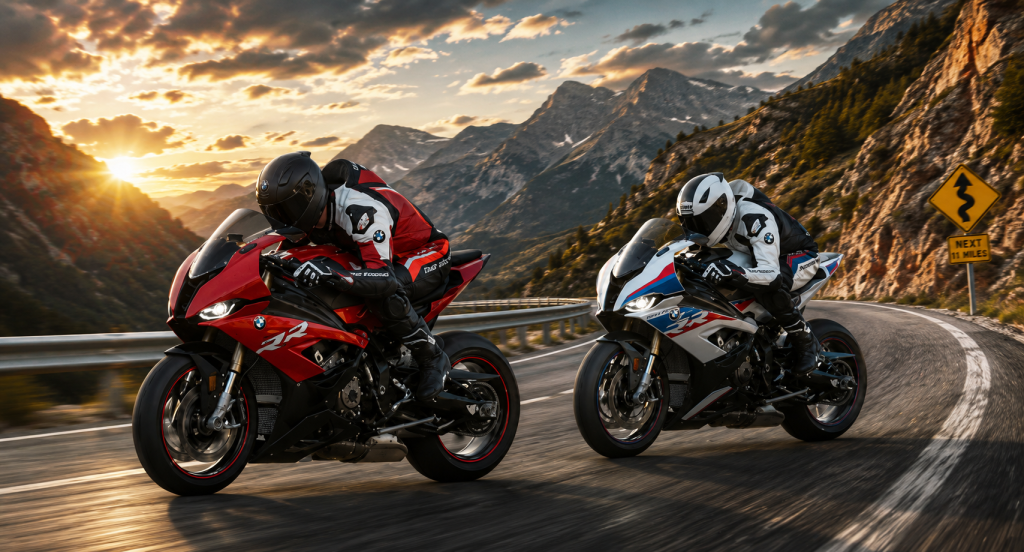
The BMW M1000RR is a road-legal superbike built from BMW’s racing program, and its latest engine update pushes output to 218 hp.

Engine and Power Output
The M1000RR uses a 999cc inline four-cylinder engine with BMW ShiftCam variable valve timing. The latest version produces 160 kW, which equals 218 hp, at 14,500 rpm. This is a gain of 6 hp over the earlier model. Peak torque stands at 113 Nm and arrives at 11,100 rpm. The engine also uses titanium valves and a compression ratio of 14.5:1, which helps it rev cleanly to redline. These figures come from BMW Motorrad.
This power increase did not come from a bigger engine. BMW achieved it through internal engine changes while keeping the same 999cc displacement. The result is a top speed of 314 km/h, which is higher than the standard S1000RR. The M1000RR shares its racing roots with the S1000RR platform but uses lighter internals for track use, as reported by Wikipedia.
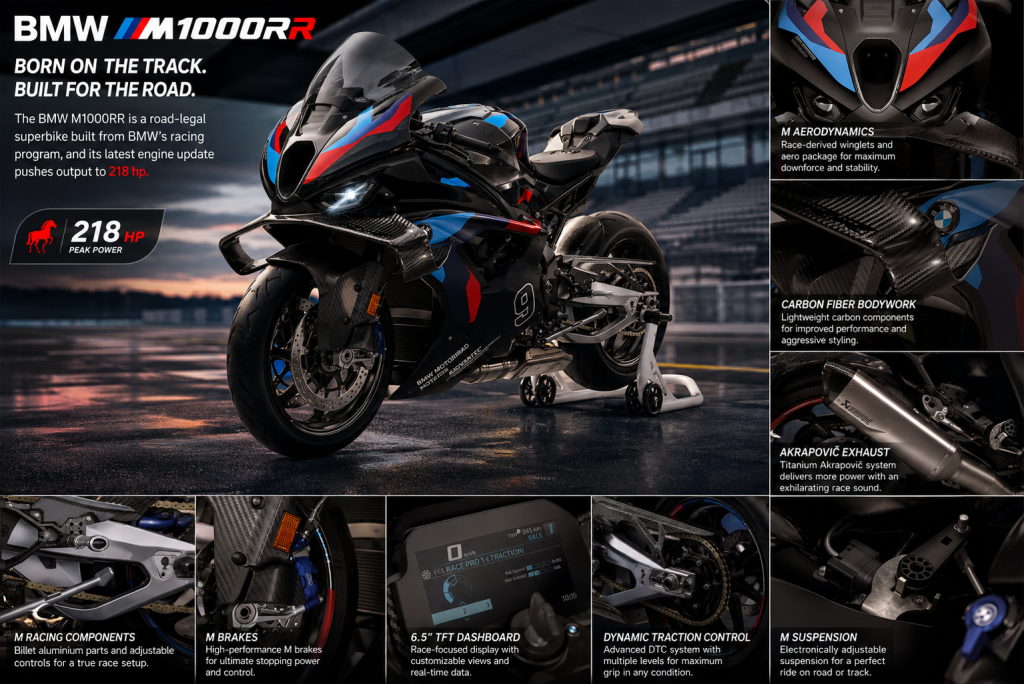
Inside the engine, BMW fitted Pankl titanium connecting rods that are lighter than those in the S1000RR. This reduces internal friction and rotating mass, which helps the engine rev faster. Forged pistons, narrow rocker arms, and optimized camshafts add to this weight saving. BMW built this engine mainly for competition use in the Superbike World Championship, according to BMW M.
M Competition Package
BMW offers the M1000RR with an optional M Competition package. This package adds carbon fiber parts, an M GPS lap trigger, an M Endurance chain, and milled brake and clutch levers. It also includes M rider footrests and a passenger kit. These parts come from BMW’s motorsport division, which also builds engines for WorldSBK and endurance racing teams, as explained by BMW Motorrad.
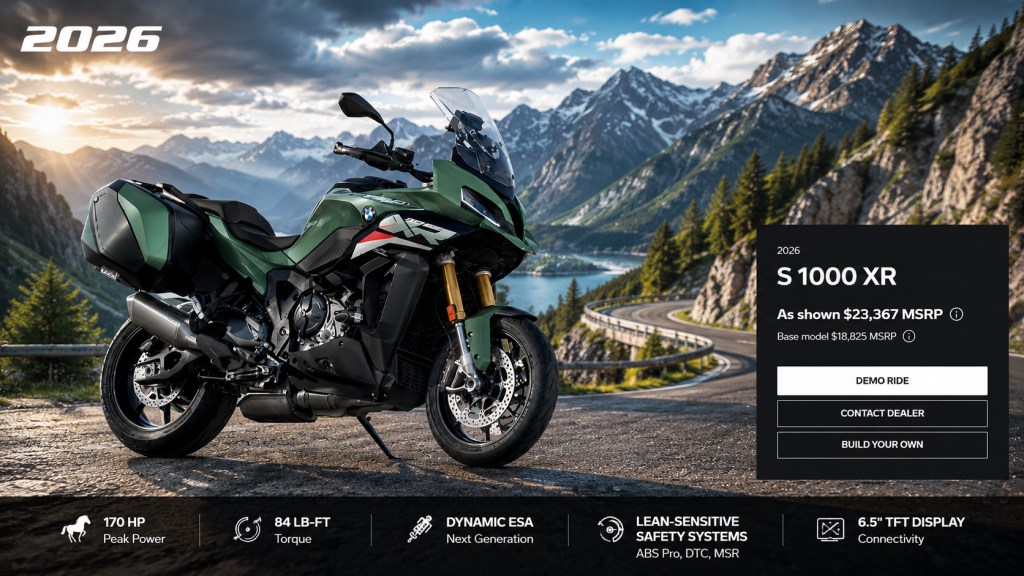
The Competition package is aimed at riders who use the bike mostly on public roads, while the base model suits track-focused riders. Pricing separates the two versions clearly, with the Competition package costing more due to its added components, based on data from Brisan Motorcycles.
Aerodynamics and Downforce
BMW redesigned the M1000RR’s bodywork to improve aerodynamics. The bike now uses M Winglet 3.0, made from carbon fiber, which produces up to 30 kg of downforce at 300 km/h. This helps keep the front wheel planted during hard acceleration and improves stability in corners. These aerodynamic upgrades were developed using wind tunnel testing and real track data, according to iMotorbike News.
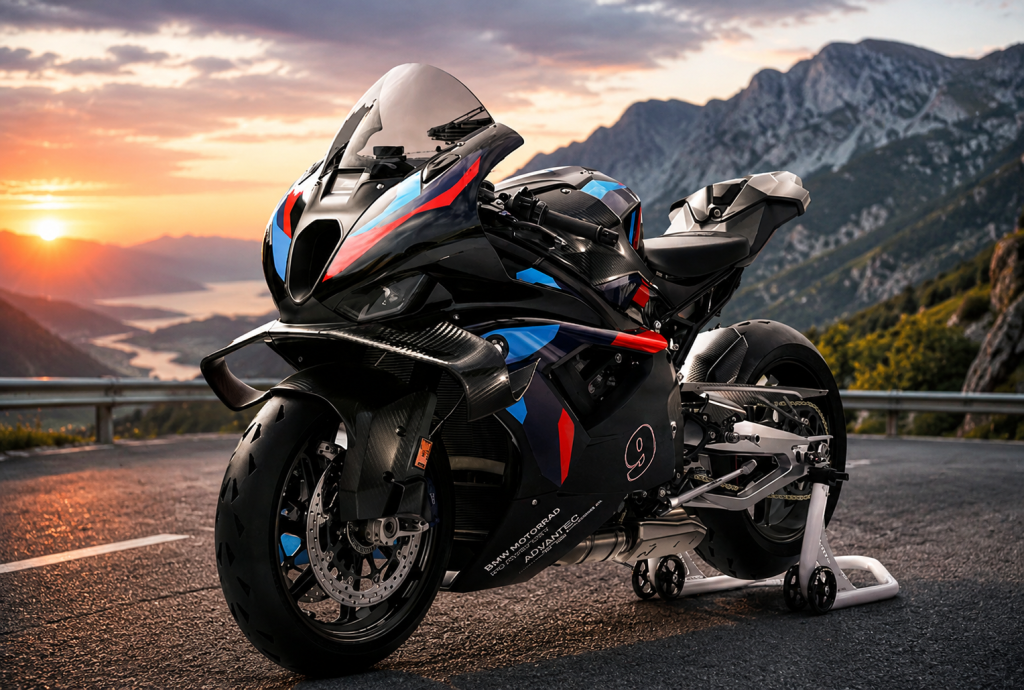
The improved aerodynamics also contribute to the higher top speed. BMW increased top speed from 306 km/h to 314 km/h partly through better airflow management around the fairing and winglets. This shows how aerodynamics work alongside engine power to improve overall performance, as noted by BMW M.
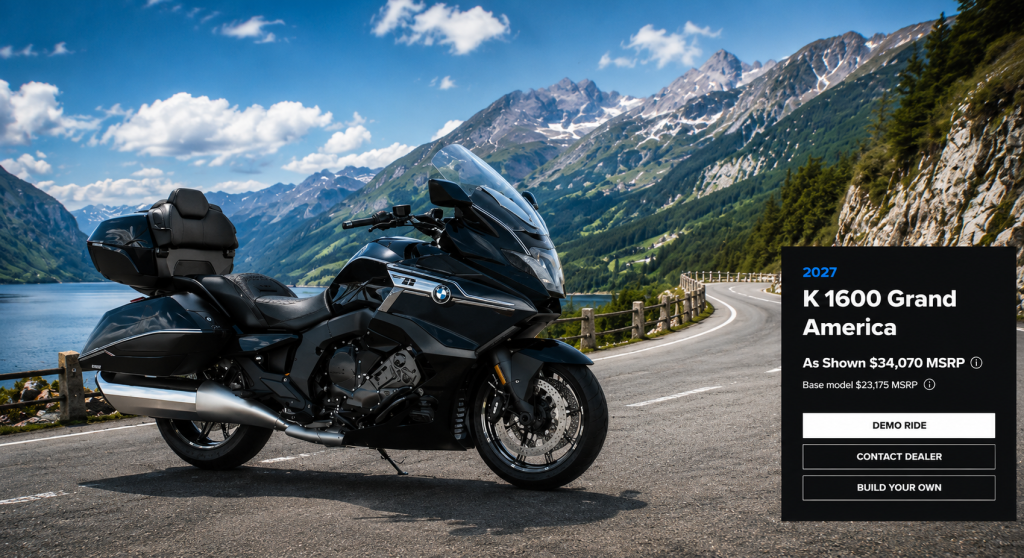
The BMW K 1600 Grand America
Traveling in pairs means experiencing every mile twice. Makes sense, right? However, with the K 1600 Grand America you will experience more. Its six-cylinder engine lets you casually cruise towards the horizon: well equipped with footboards, a top case featuring a backrest and high windscreen. As a result, it won’t be easy to say which was the most beautiful moment of the tour at the end of each day. Still, the stories about every mile will feel at least twice as good. Simply put: BMW 2027
Weight and Chassis
The M1000RR uses lightweight materials such as titanium and carbon fiber throughout the chassis and bodywork. This keeps the unladen weight around 193 kg, which is light for a liter-class superbike with this much power. The frame is designed specifically for racing use while still meeting road registration rules, according to Torquepedia.
Lower weight combined with high horsepower gives the M1000RR a strong power-to-weight ratio. This is one reason the bike performs well on racetracks against other homologated superbikes. Riders who want the lightest possible setup can also choose optional M Carbon wheels, which cut rotating mass even further, as reported by TopSpeed.
Electronics and Rider Aids
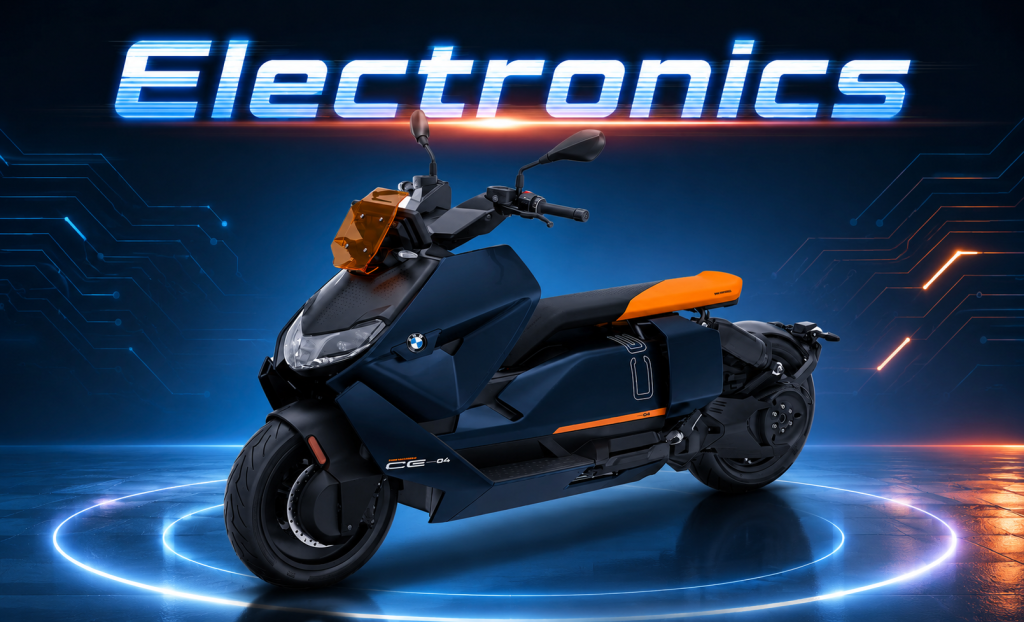
The M1000RR comes with a full electronics suite that covers both road and race riding modes. Riders can choose from settings ranging from Rain mode to Race Pro modes, which adjust traction control, engine braking, and throttle response. This range of settings lets one rider use the bike for daily riding and track days without needing a different machine, according to Torquepedia.
The bike also includes a slipper clutch that reduces rear wheel hop during hard downshifts. This system helps riders brake late into corners without losing control of the rear tire. Because the M1000RR is homologated for racing, its electronics package meets the technical rules required for competition use, as explained by TopSpeed.
Racing Background
BMW built the M1000RR to compete directly in top-level motorcycle racing. The bike has taken wins in the World Superbike Championship, the FIM Superbike Championship, and the FIM Endurance World Championship. BMW also supports racers and teams through its Motorsport Race Support program, which has offered specialized parts and engine work since 2010, according to BMW Motorrad.
This racing connection means the road-going M1000RR shares many parts and engineering choices with bikes used on the track. The same specialists who build engines for BMW’s WorldSBK program also work on upgrades available to private owners, which is a key reason enthusiasts see this model as a genuine race bike for the street, based on details from BMW Motorrad.
Key Specifications
| Specification | Detail |
|---|---|
| Engine | 1250 CCM twin-cylinder boxer engine |
| Max power | 218 hp at 14,500 rpm |
| Max torque | 113 Nm at 11,100 rpm |
| Top speed | 314 km/h |
| Compression ratio | 14.5:1 |
| Unladen weight | Approx. 193 kg |
| Downforce (M Winglet 3.0) | Up to 30 kg at 300 km/h |
Data compiled from BMW Motorrad and Torquepedia.
Who the M1000RR Is Built For
The M1000RR is designed for experienced riders who want a bike close to a race machine. Its tall seat, firm suspension, and track-focused riding position make it less comfortable for daily commuting compared to standard sport bikes. Riders looking for a relaxed street bike may find it demanding, while track riders will value its precision and power delivery, according to TopSpeed.
Despite its race focus, the bike remains street legal and comes with a standard warranty. This makes it possible for owners to ride it on public roads while also entering track day events or amateur racing series, as confirmed by Motorcycle
FAQ: BMW M1000RR
Q: What makes the BMW M1000RR different from the standard S1000RR?
The M1000RR is BMW’s homologation-special superbike, built by the M division specifically for racing. It features a more powerful ShiftCam engine (218 HP), lighter carbon-fiber components, adjustable aerodynamic winglets, and track-focused suspension not found on the standard S1000RR.
Q: How much horsepower does the BMW M1000RR have?
The current BMW M1000RR produces 218 horsepower from its ShiftCam inline-four engine, making it one of the most powerful production superbikes available.
Q: Is the BMW M1000RR street legal?
Yes, the M1000RR is street legal, though it’s engineered predominantly for racetrack performance rather than everyday road riding. Its ergonomics and setup favor track use over daily commuting.
Q: What is BMW’s M division, and why does it matter for the M1000RR?
BMW M is the brand’s legendary motorsport division, known for high-performance road cars. The M1000RR marks BMW Motorrad’s flagship collaboration with M, bringing racing-grade engineering to a production motorcycle.
Q: How much does the BMW M1000RR cost?
Pricing varies by region and model year, typically positioning it as a premium, top-tier superbike well above the standard S1000RR — often significantly more expensive due to its race-spec components.
Q: Who should buy the BMW M1000RR?
It’s best suited for experienced riders, track-day enthusiasts, and racers seeking a homologated superbike with race-ready performance, rather than casual or beginner riders.
Q: What racing series is the M1000RR designed to compete in?
The M1000RR is built to meet homologation requirements for superbike racing series such as WorldSBK, allowing teams to campaign a production-based version in competition.