










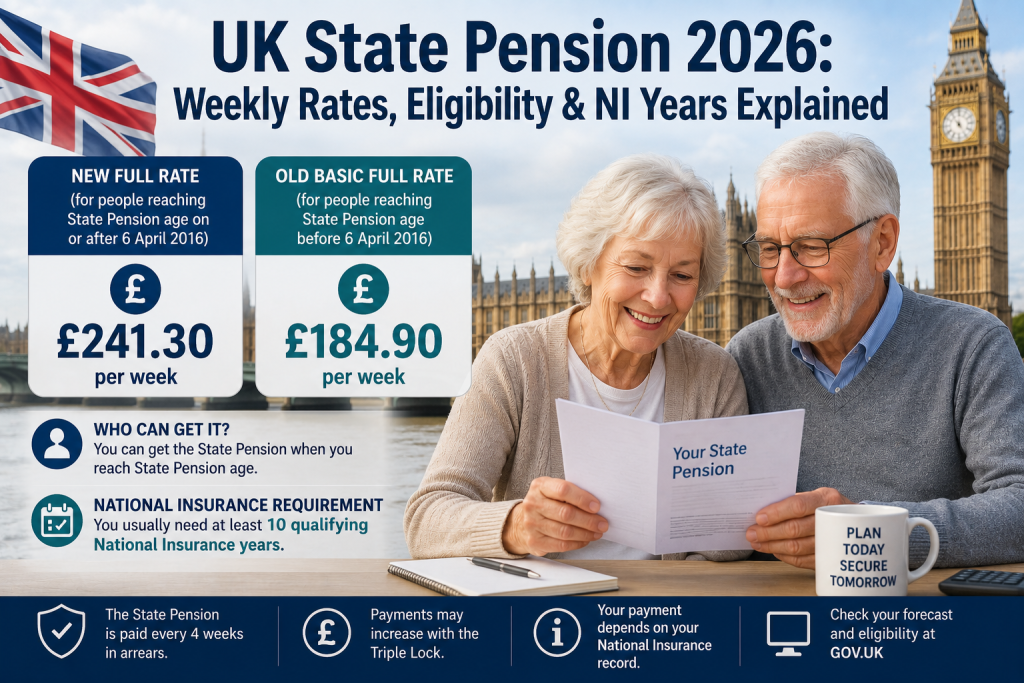
The full new State Pension is £241.30 a week in 2026/27, and the full basic State Pension is £184.90 a week. Your actual payment depends on your National Insurance record and which pension scheme applies to you.

New State Pension Weekly Rate 2026/27
From April 2026, the full new State Pension pays £241.30 a week, which works out to £12,547.60 a year. This rate applies for people who reached State Pension age on or after 6 April 2016, and payments are made every four weeks in arrears. This is a 4.8% rise from the previous rate of £230.25 a week.
Basic State Pension Weekly Rate 2026/27
If you reached State Pension age before 6 April 2016, you fall under the old basic State Pension rules. The full basic State Pension is £184.90 a week, which comes to £9,614.80 a year. This scheme requires fewer qualifying years than the new scheme, since the old system was based on 30 qualifying years rather than 35. (Retirement Expert)
| Pension Type | Weekly Rate 2026/27 | Yearly Amount | Who It Applies To |
|---|---|---|---|
| New State Pension | £241.30 | £12,547.60 | Reached State Pension age on or after 6 April 2016 |
| Basic State Pension | £184.90 | £9,614.80 | Reached State Pension age before 6 April 2016 |
Who Is Eligible for the State Pension
Eligibility mainly depends on your age and your National Insurance record. You must reach your State Pension age, and you need a certain number of qualifying years of National Insurance contributions or credits to receive any payment at all. You can still receive National Insurance credits without working, for example through Child Benefit claims for a child under 12, Carer’s Allowance, Jobseeker’s Allowance, or Employment and Support Allowance. (GovtSchemes)

National Insurance Years Explained
Your National Insurance record decides how much State Pension you get. For the full new State Pension, you usually need 35 qualifying years of contributions or credits, and you need at least 10 years to receive anything at all. Qualifying years can come from paid Class 1, Class 2, or Class 3 contributions, or from National Insurance credits. (Retirement Expert)
| Requirement | New State Pension | Basic State Pension |
|---|---|---|
| Minimum years for any payment | 10 years | Fewer than 30 years gives partial rate |
| Years needed for full rate | 35 years | 30 years |
If you have gaps in your National Insurance record, this can lower your final payment. Checking your National Insurance record helps you find out if you have paid enough contributions to qualify for the full pension, and filling gaps can sometimes boost your pension. (Carehome)
State Pension Age in 2026
The age at which you can claim your State Pension is changing. State Pension age is currently rising from 66 to 67, and this change is being phased in between 6 April 2026 and 5 April 2028 under the Pensions Act 2014. If you were born before 6 April 1960, your State Pension age is 66. If you were born between 6 April 1960 and 5 March 1961, you fall into a transitional band, somewhere between 66 years and 1 month and 66 years and 11 months. (Retirement Expert)
How the Triple Lock Works
The triple lock decides how much the State Pension rises each year. Both the new and basic rates rose by 4.8% from 6 April 2026, based on average weekly earnings growth measured between May and July 2025. Under this rule, State Pension payments increase each year in line with whichever is highest among average earnings growth, the September Consumer Prices Index inflation rate, or 2.5%. (MSN Money) RetirementExpertMSN
Tax on the State Pension
The State Pension counts as taxable income, even though tax is not deducted automatically from it. At £12,548 a year, the full new State Pension sits just £22 below the frozen Personal Allowance of £12,570, so any extra private pension income will be taxed at the basic rate from the first pound. This means many pensioners with other income sources may need to plan carefully for tax. (UK Pension Planner) Ukpensionplanner
How to Check Your State Pension Forecast
The best way to know your exact entitlement is to check your personal forecast. Checking your forecast tells you how much you are on track to receive, when you can claim it, and whether you can increase your amount. You can check your National Insurance record and State Pension forecast for free on GOV.UK. (UK Pension Planner) CarehomeRetirementExpert
Deferring Your State Pension
You do not have to claim your State Pension as soon as you reach State Pension age. This pension can be deferred to increase the amount you receive later, and it is possible to claim your new State Pension even if you carry on working. Deferring is a personal choice and depends on your income needs and health. Carehome
FAQs: UK State Pension 2026
Q: How much is the UK State Pension in 2026?
Q: What’s the difference between the new and basic State Pension?
Q: How many National Insurance years do I need to qualify?
Q: Why did the State Pension increase in 2026?
The rise follows the triple lock rule, which increases payments each April by whichever is highest of three measures: CPI inflation, average earnings growth, or a 2.5% minimum. In 2026, the increase was driven by average earnings growth, making it the largest earnings-driven State Pension rise since 2010.
Q: What is the annual value of the new State Pension in 2026?
Q: Can I get State Pension if I worked abroad?
Q: What if I don’t have enough NI years for a full pension?
Q: When will the next State Pension increase happen?
State Pension rates are reviewed and updated every April under the triple lock. The 2026/27 rates took effect from April 6, 2026, and the next update is expected in April 2027.