








Federal financial aid is changing in major ways starting July 1, 2026. The One Big Beautiful Bill Act (OBBBA) lowers loan limits, ends Grad PLUS loans, and tightens Pell Grant eligibility for millions of students.

What Is the One Big Beautiful Bill Act
The One Big Beautiful Bill Act, also called OBBBA or Public Law 119-21, was signed into law on July 4, 2025. It is a reconciliation bill that includes sweeping reforms to federal student aid. Most provisions take effect on July 1, 2026, which means they apply to the 2026-27 award year and beyond.
The law changes three main areas of federal aid. These are Pell Grant eligibility, federal student loan limits, and loan repayment plans. The Department of Education has been issuing guidance and final rules through 2026 to help schools and borrowers prepare.
Why People Are Calling This FAFSA Turmoil
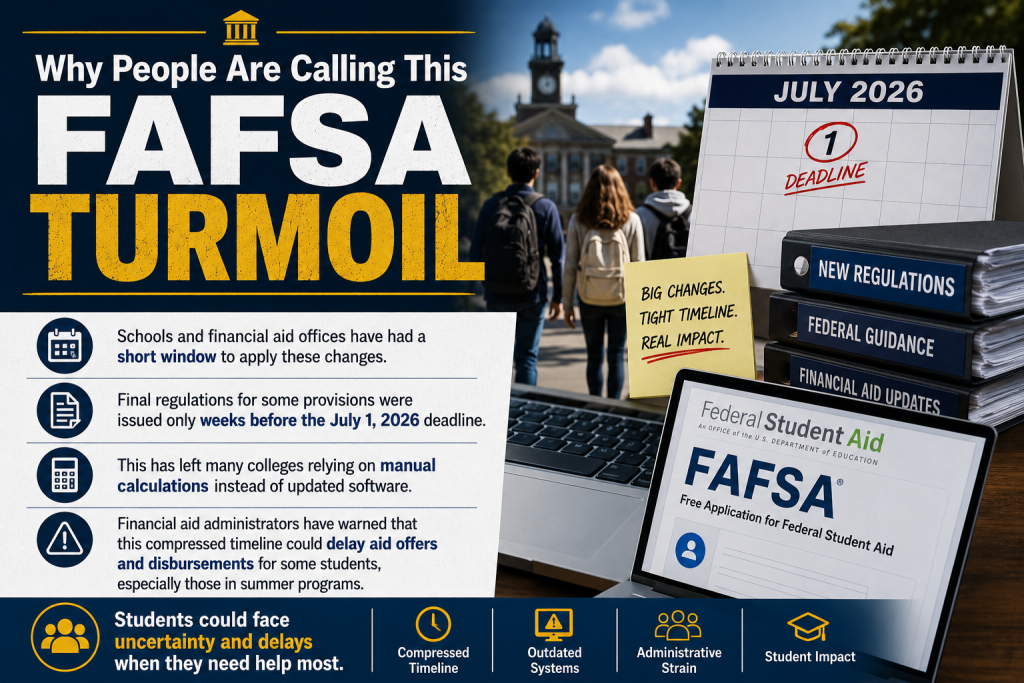
Schools and financial aid offices have had a short window to apply these changes. Final regulations for some provisions were issued only weeks before the July 1, 2026 deadline. This has left many colleges relying on manual calculations instead of updated software. Financial aid administrators have warned that this compressed timeline could delay aid offers and disbursements for some students, especially those in summer programs.
At the same time, the FAFSA form itself launched earlier and more smoothly than in the past two years. The 2026-27 FAFSA opened on September 24, 2025, the earliest launch on record. So the turmoil is less about the form and more about the policy changes happening behind it.
New Pell Grant Eligibility Rules
Pell Grants help low-income undergraduate students pay for college. Under OBBBA, the rules for who qualifies have become stricter.
| Pell Grant Change | Detail |
|---|---|
| SAI cutoff | Students with a Student Aid Index (SAI) of $14,790 or more for 2026-27 are not eligible for any Pell Grant |
| Full scholarship rule | Students whose non-federal scholarships or grants cover their entire cost of attendance lose Pell eligibility |
| Maximum award | The maximum Pell Grant for 2026-27 stays at $7,395 per year |
| Workforce Pell | Short-term workforce training programs can now qualify students for Pell Grants |
| Bachelor’s degree holders | Students who already hold a bachelor’s degree can now get a Pell Grant if enrolled in an eligible workforce program |
The SAI cutoff is set at twice the maximum Pell award. This means the cutoff will move if the maximum Pell amount changes in future years.
New Federal Student Loan Limits
OBBBA sets a lifetime borrowing cap across all federal student loans. This cap is $257,500 per borrower. Parent PLUS loans are not counted toward this lifetime limit.
| Loan Type | New Annual or Lifetime Limit |
|---|---|
| Graduate students | $20,500 per year, $100,000 lifetime |
| Professional students | $50,000 per year, $200,000 lifetime |
| Combined graduate and professional aggregate | $200,000 total |
| Overall lifetime limit (all federal loans) | $257,500 |
Special medical training programs that once allowed higher unsubsidized loan limits, up to $224,000 in some cases, lose that higher limit on July 1, 2026.
Graduate PLUS Loans Are Ending
The Graduate PLUS Loan program is eliminated for new borrowers starting July 1, 2026. This program previously let graduate students borrow up to their full cost of attendance. Going forward, new graduate borrowers can only use Direct Unsubsidized Loans, subject to the new annual and lifetime caps listed above.
Parent PLUS Loan Changes
Parent PLUS loans are also capped for the first time. Before OBBBA, parents could borrow up to the full cost of attendance for their child, with no fixed ceiling.
| Parent PLUS Rule | New Limit (Effective July 1, 2026) |
|---|---|
| Annual limit per student | $20,000 per year |
| Lifetime limit per student | $65,000 total |
| Repayment plan access | Income-driven repayment is no longer available for new Parent PLUS loans unless consolidated |
These limits apply per student, not per parent. If both parents borrow for the same child, their combined borrowing still cannot exceed these amounts.
Loan Proration for Part-Time Students
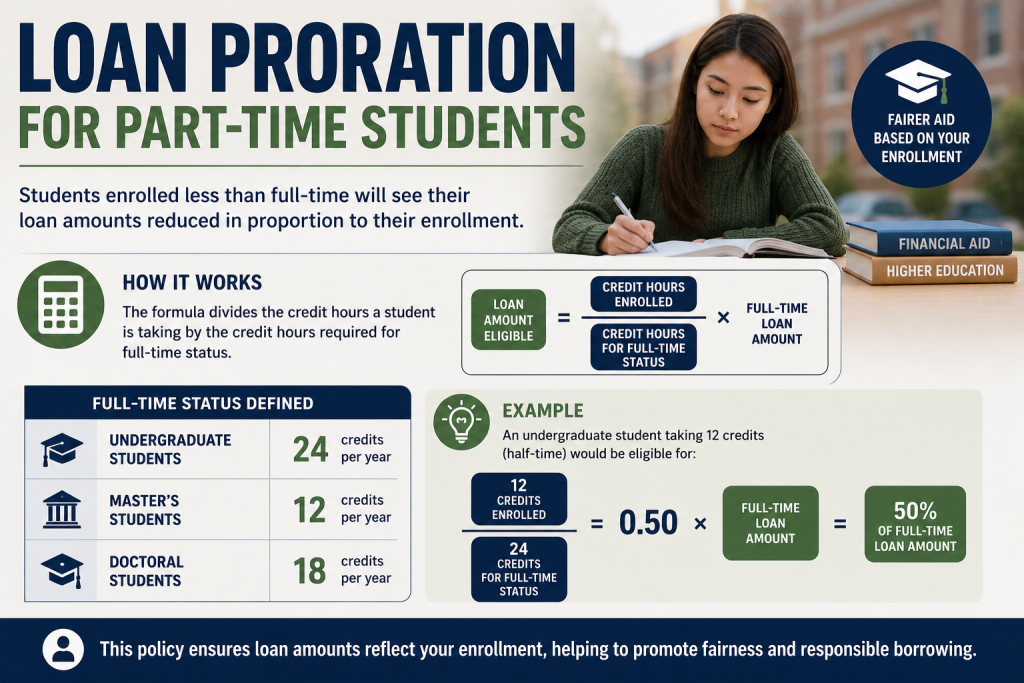
Students enrolled less than full-time will see their loan amounts reduced in proportion to their enrollment. The formula divides the credit hours a student is taking by the credit hours required for full-time status. Full-time status is defined as 24 credits per year for undergraduates, 12 for master’s students, and 18 for doctoral students.
Legacy Borrower Protections
Not every borrower is affected right away. OBBBA includes legacy provisions for students who already have a federal loan disbursement before July 1, 2026.
To qualify as a legacy borrower, a student generally must have:
- Received at least one loan disbursement before July 1, 2026, while enrolled in their current program
- Remained continuously enrolled in that same program without a gap or transfer
Legacy status lasts for three years from the start of the program, or until the program is finished, whichever happens first. Switching majors, transferring schools, or taking a leave of absence can end legacy protection and move a student to the new rules.
New Repayment Plan: RAP
OBBBA creates a new repayment option called the Repayment Assistance Plan (RAP). This is an income-driven plan based on a borrower’s Adjusted Gross Income (AGI) and number of dependents.
Key RAP details:
- Minimum monthly payment is $10
- Married borrowers who file taxes separately have their income and dependents calculated separately from their spouse
- If a payment reduces the loan principal by less than $50, the Department of Education will cover the difference, up to $50
Borrowers currently in older income-driven repayment plans have until July 1, 2028, to choose between RAP, Income-Based Repayment (IBR), or a Standard Plan. After that date, older repayment plans will be phased out, and unselected accounts will move automatically to RAP or IBR depending on eligibility.
Why FAFSA Processing Has Faced Delays
Several factors are contributing to slower processing and confusion in 2026, separate from OBBBA itself.
- Staffing reductions at the Department of Education have led to slower responses from federal call centers and case teams.
- System updates were rolled out close to the deadline. Major changes to the FAFSA Processing System, the National Student Loan Data System (NSLDS), and the Common Origination and Disbursement (COD) system went live on April 26, 2026, just over two months before the new rules took effect.
- Higher application volume. FAFSA submissions rose sharply for the 2026-27 cycle, adding pressure to financial aid offices that are also adjusting to new federal rules.
- Software readiness. Many schools rely on third-party financial aid software, and some vendors were still updating their systems to match the new federal requirements close to the deadline.
NASFAA surveys of financial aid offices found a majority reported delays in federal responsiveness and FAFSA or ISIR processing during 2026 compared to earlier periods.
Key Dates to Remember
| Date | Event |
|---|---|
| July 4, 2025 | OBBBA signed into law |
| September 24, 2025 | 2026-27 FAFSA form launched |
| April 26, 2026 | FAFSA Processing System, NSLDS, and COD updates went live |
| July 1, 2026 | Most OBBBA loan and Pell Grant changes take effect |
| June 30, 2026 | Deadline to file the 2025-26 FAFSA |
| July 1, 2028 | Deadline to choose a new repayment plan under the RAP transition rules |
What Students and Families Should Do Now
- File the FAFSA as early as possible for the 2026-27 award year, since aid amounts can be limited and processing may take longer than usual.
- Check whether you or your child qualifies for legacy borrower protections before the July 1, 2026 cutoff.
- Review the new SAI cutoff for Pell Grant eligibility, especially if your SAI is close to $14,790.
- Contact your school’s financial aid office directly if you have not received an updated aid offer, since many offices are processing changes manually this year.
- If you are in repayment, review your current plan before 2028 to avoid being automatically moved to a new plan you did not choose.
Frequently Asked Questions
Does OBBBA affect Federal Work-Study eligibility? No. Work-Study eligibility is still based on financial need as determined by the FAFSA and each school’s own policies.
Will current students lose their existing federal loans? No. Loans already disbursed remain under their original terms. The new limits apply to new borrowing after July 1, 2026, except where legacy provisions apply.
Is the maximum Pell Grant amount changing? No. The maximum Pell Grant for 2026-27 stays at $7,395. What changed is who qualifies for it.
Can I still get a Grad PLUS loan after July 1, 2026? Only if you already received a disbursement for your current program before that date and remain continuously enrolled. New borrowers cannot access Grad PLUS loans after the deadline.