













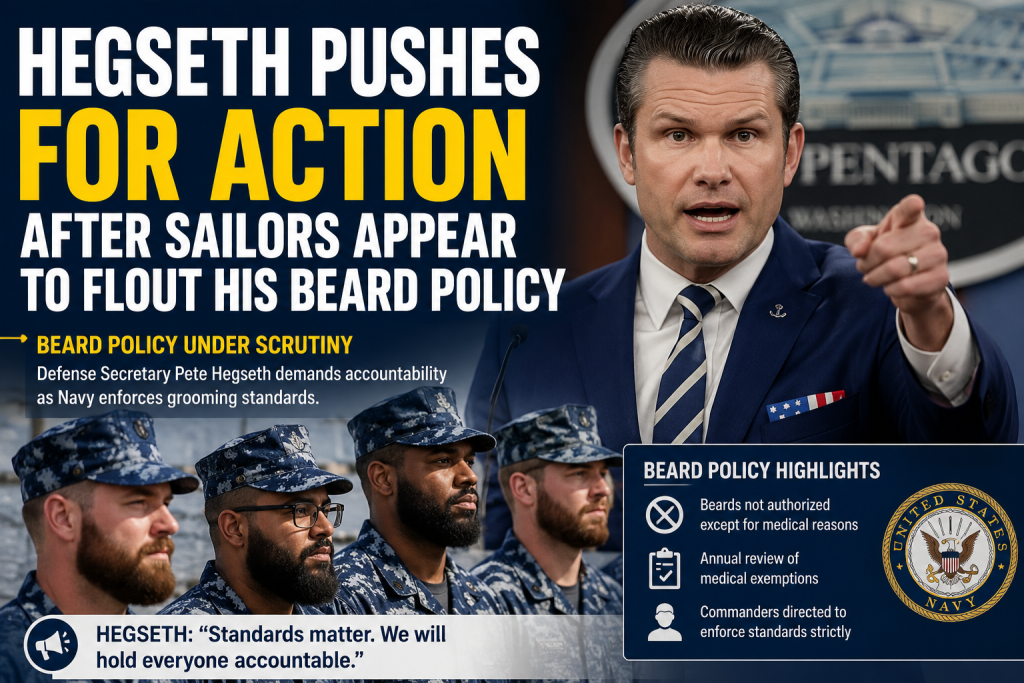
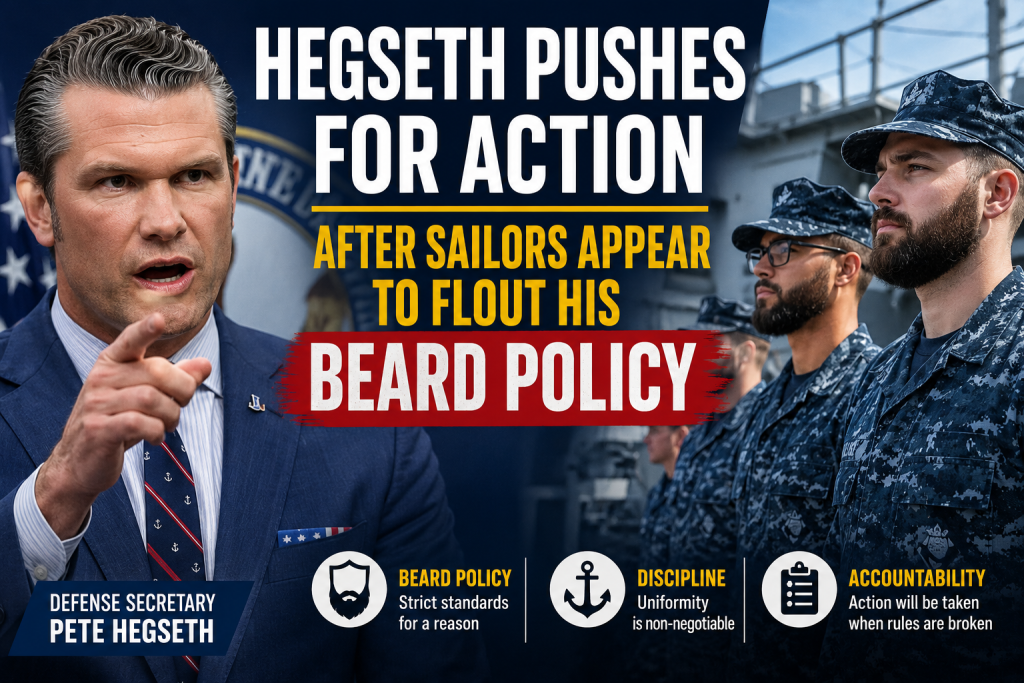
Defense Secretary Pete Hegseth is pushing for stricter enforcement of his military beard ban after seeing sailors with beards during a Navy ship visit.

What Happened On The Ship Visit
As tensions with Iran remained high in recent weeks, Hegseth boarded a Navy ship for what was meant to be a routine visit with sailors. During the visit, he noticed multiple sailors wearing beards, which appeared to violate the stricter beard policy he had issued the previous year, according to a defense official and emails reviewed by CNN. CNN
Why Hegseth Reacted Strongly
After the visit, Hegseth left wondering whether staff across the Pentagon were actually following his beard policy and other workplace changes he had ordered, based on internal accounts reported by CNN. Shortly afterward, Pentagon officials held a series of meetings where they told subordinates that Hegseth was closely watching progress on the beard policy, with pressure coming from political appointees to move faster, according to CNN. CNNCNN
The Original Beard Policy
In September 2025, Hegseth issued a memo that tightened restrictions on beards and limited medical exemptions, reversing years of a more relaxed approach. Hegseth told servicemembers that he wanted “no more beardos” in the military, saying the era of shaving profiles was over and that anyone who did not want to shave should consider a new profession, according to remarks reported by ABC10. ABC10
Why Hegseth Says Beards Are A Problem
Hegseth has argued that beards create a safety risk because they can stop service members from properly sealing protective masks during chemical or biological threats, according to ABC10. The military had gradually become more accepting of beards in past years, granting thousands of medical and religious exemptions before this policy reversed that trend, based on reporting from CNN. CNN
Emmy Nominations 2026 | Primetime Emmy Awards Full List of Nominees
The 78th Primetime Emmy Awards nominations were announced on July 8, 2026, with HBO Max’s “The Pitt” leading all shows with 25 nominations. When…

New Navy Rules On Medical Waivers
The Navy has now placed a strict limit on how long sailors can hold medical shaving waivers. Under updated guidance, medical waivers will be evaluated in 90 day increments and cannot be extended beyond one year, according to a Navy-wide message reported by Task & Purpose. Sailors with skin conditions caused by shaving, including pseudofolliculitis barbae, will no longer receive permanent waivers, and commanders may only grant a 90 day waiver up to four times before recommending further action, according to Stars and Stripes.
What Happens If Sailors Cannot Comply
If treatment does not allow a sailor to return to shaving within the allowed time, commanders may begin the process to separate that sailor from the Navy, according to Stars and Stripes. The policy also affects new recruits, since temporary medical shaving waivers will not be granted to anyone newly entering the service, based on details reported by Fori.us.
Who Is Exempt From The Rule
Certain special operations members, including Navy SEALs, may still wear beards in specific operational settings where it is considered mission essential. However, those same forces must be clean shaven when deployed to areas with a chemical, biological, radiological, or nuclear threat, according to Stars and Stripes. Mustaches remain allowed under the current guidance, based on the same Navy memo reported by Stars and Stripes.
Updated Navy Grooming Rules At A Glance
| Rule | Detail |
|---|---|
| Medical waiver limit | Maximum of 1 year total |
| Waiver review period | Every 90 days |
| Maximum 90 day extensions | 4 times |
| New recruits | No temporary shaving waivers granted |
| Non-compliance after 1 year | Possible administrative separation |
| Mustaches | Still permitted |
| Special operators (mission essential) | Limited beard allowance, must shave in CBRN threat zones |
Criticism Of The Policy
Critics say the policy does not properly account for pseudofolliculitis barbae, a painful skin condition caused by shaving that disproportionately affects Black men, according to CNN. The Army has previously studied how beards affect the seal of gas masks and had approved exemptions in the past, based on details reported by CNN. CNNCNN
Q: Why is Defense Secretary Pete Hegseth pushing for action against sailors over beards?
During a Navy ship visit, Hegseth noticed multiple sailors sporting beards, apparently violating a stricter policy restricting beards in most instances that he issued last year. He left the ship wondering if the Pentagon rank-and-file paid attention to his beard policy and other policy changes he has made to the workforce.
Q: Which ships did Hegseth visit when he noticed the beard violations?
CNN could not determine which ship visit prompted Hegseth’s crackdown, though he visited the USS Carl Vinson in San Diego in June and the USS Boxer in Singapore in May.
Q: What is the Pentagon doing in response to Hegseth’s concerns?
Pentagon officials held a series of meetings in which they told subordinates that Hegseth was closely monitoring agencies’ progress on the beard policy and other workplace changes, and that there was pressure from political appointees to move faster on the directives.
Q: What exactly does Hegseth’s beard policy require?
In September, Hegseth issued a memo that tightened restrictions on beards and the granting of medical-based exemptions to grow them, reversing years of more accommodating policy. His memo argued that beards were a national security issue because they could prevent service members from safely donning protective equipment in response to chemical or biological threats.
Q: What happens to sailors who can’t shave for medical reasons?
Sailors who cannot shave due to medical reasons now have one year before they could face separation over their inability to go clean shaven, and commands have the option to offer 90-day waivers up to that one-year limit. Sailors will be evaluated for administrative separation if they are unable to meet grooming standards after that period.
Q: Are there any exceptions to the beard ban?
Sailors do have the option of maintaining a mustache. Additionally, there are 1,000 facial hair religious accommodations in the Navy that the service must reevaluate under new standardized procedures, and religious accommodations allow beards up to a quarter inch at sea and 2 inches ashore.
Q: Why are critics concerned about this policy?
Critics argue the policy disproportionately harms Black service members who suffer from pseudofolliculitis barbae (PFB), a shaving-related skin condition. Under the new policy, commanders can kick out military personnel who require a shaving waiver after a year of medical treatment for PFB. Richard Brookshire, co-founder of the Black Veterans Project, said the policy “allows for an environment of hostility to our Black troops in uniform in part because it opens them up to greater harassment from their senior enlisted.”
Q: When will the first separations under the new medical waiver rules take effect?
The first separations for failure to adhere to grooming standards due to a medical condition will not happen until July 7, 2027, a year from the NAVADMIN’s release.