












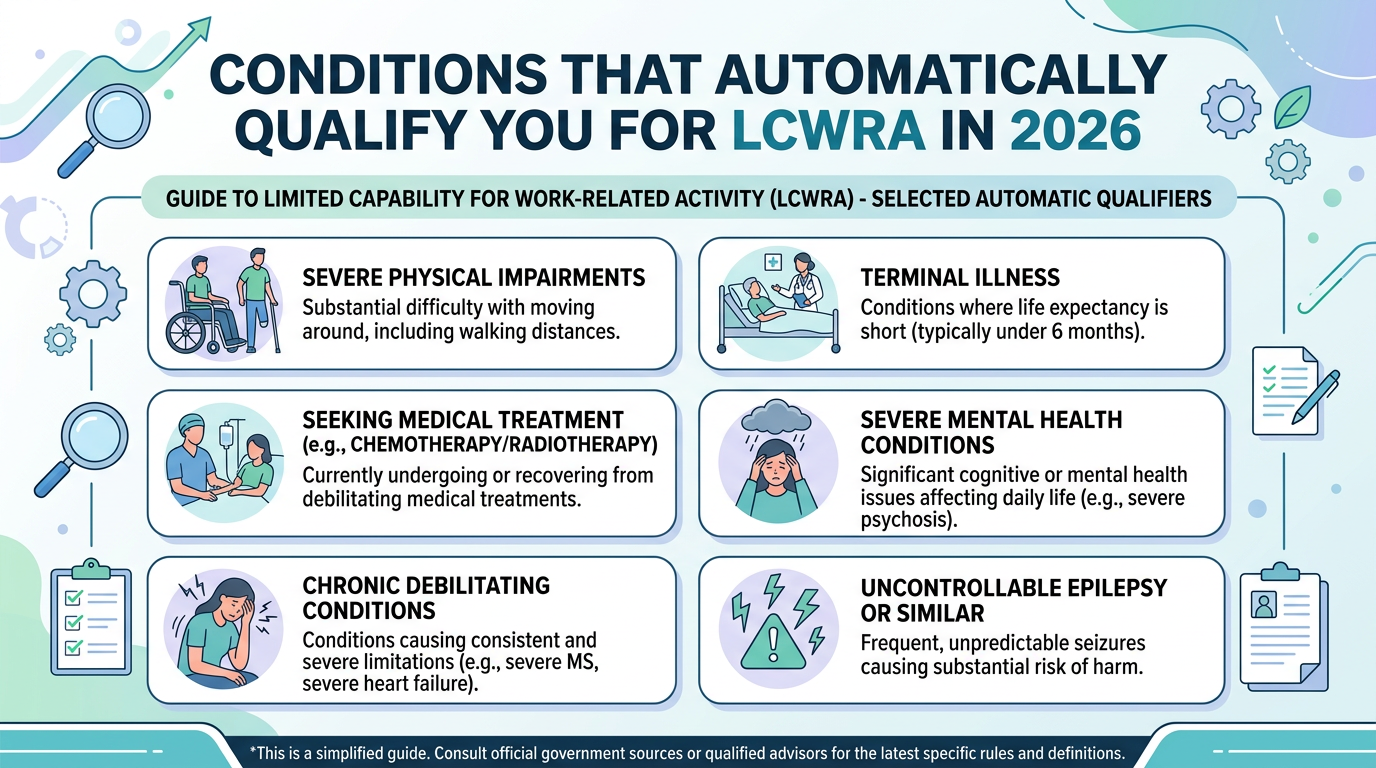
There is no official list of named medical conditions that automatically qualify someone for LCWRA. Instead, the DWP uses specific rules and descriptors based on how a condition affects daily function.

What LCWRA Actually Means
LCWRA stands for Limited Capability for Work-Related Activity. People placed in this group do not have to look for work or prepare for work. They receive an extra payment called the LCWRA element on top of their standard Universal Credit, according to Citizens Advice.
Why There Is No Simple Condition List
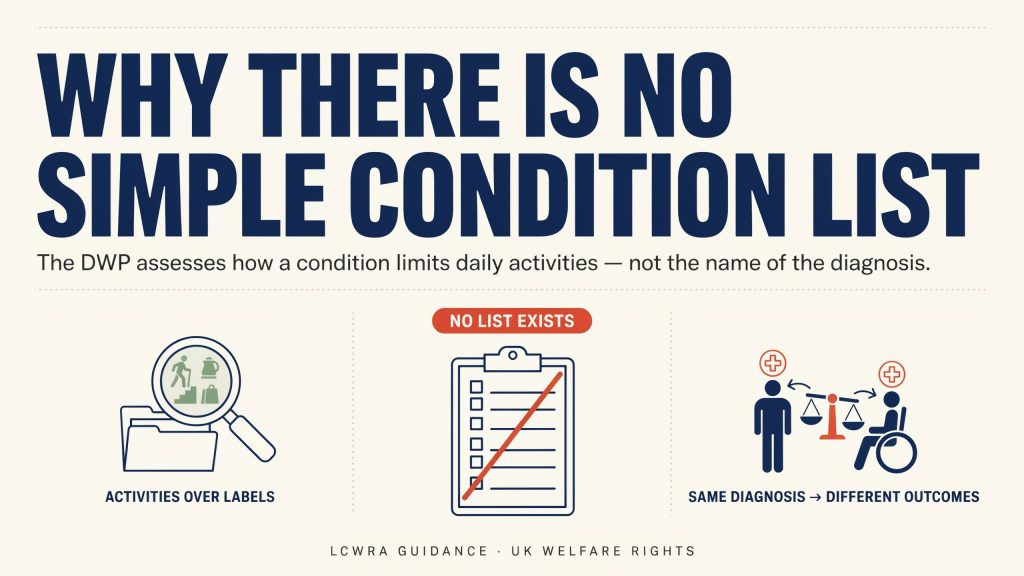
Many people search for a list of conditions that guarantee LCWRA status. This list does not exist. The DWP looks at how a condition limits someone’s daily activities, not the name of the diagnosis itself. Two people with the same condition can get different outcomes depending on how it affects them, based on guidance from Advicenow.
Automatic Qualification Through Descriptors
Some descriptors on the Work Capability Assessment lead to automatic LCWRA placement. This happens if a claimant scores 15 points on a single descriptor, except in a few specific activity areas. Meeting any descriptor in Activity 18 or Activity 19 also leads to automatic qualification. The limitation must apply at all times and be expected to last permanently, and it must be confirmed by an NHS diagnosis, according to Advicenow.
Terminal Illness Rules
Claimants who are terminally ill and not expected to live more than 12 months automatically qualify for LCWRA. This falls under the Special Rules for End of Life. A health professional completes a form confirming the prognosis, so the claimant does not need to complete a UC50 form or attend a Work Capability Assessment, based on information from Citizens Advice.
HMRC Admitted Overtaxing Millions of State Pensioners Since 2010 — Are You Owed a Refund?
HMRC has confirmed it overtaxed up to 1.4 million pensioners due to an error dating back to 2010, and refunds are available through specific…

Substantial Risk Rules
Someone who does not meet a specific descriptor may still qualify if being told to prepare for work would create a substantial risk to their health or someone else’s health. This is often called the substantial risk rule and requires clear medical evidence, according to Advicenow.
Moving From ESA Without A Break In Claim
Claimants who were in the ESA Support Group and move to Universal Credit without any gap in their claim are usually placed straight into the LCWRA group. In most cases, they do not need a new assessment unless their circumstances change significantly, based on details from Citizens Advice.
Payment Rates And The April 2026 Change
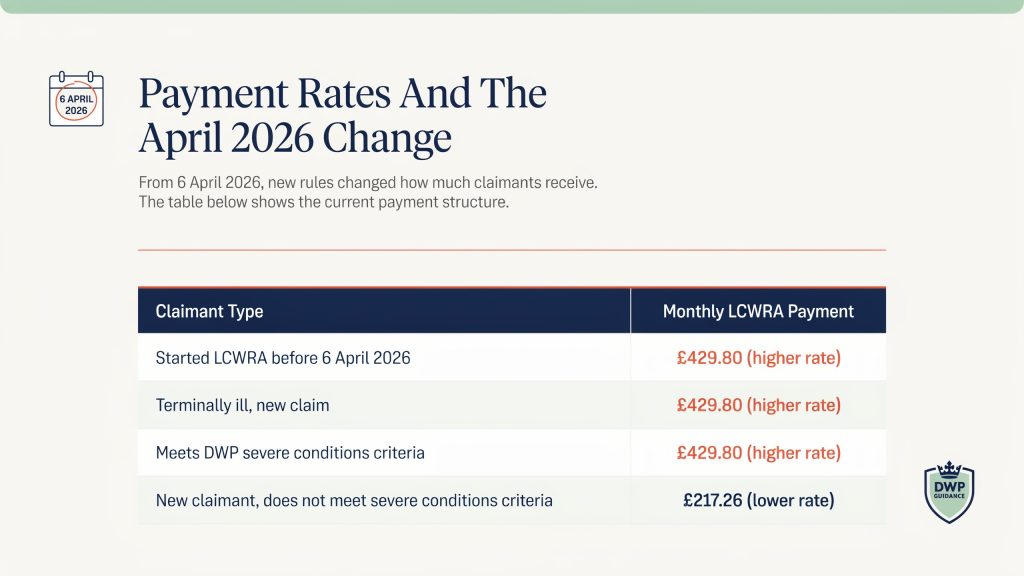
From 6 April 2026, new rules changed how much claimants receive. The table below shows the current payment structure.
| Claimant Type | Monthly LCWRA Payment |
|---|---|
| Started LCWRA before 6 April 2026 | £429.80 (higher rate) |
| Terminally ill, new claim | £429.80 (higher rate) |
| Meets DWP severe conditions criteria | £429.80 (higher rate) |
| New claimant, does not meet severe conditions criteria | £217.26 (lower rate) |
This information comes directly from Citizens Advice.
What Counts As A Severe Condition Under The New Rules
Claimants who report a health condition on or after 6 April 2026 must meet the DWP’s severe conditions criteria to get the higher payment rate. This means at least one automatic LCWRA descriptor must apply at all times and be expected to remain permanent, based on guidance from Citizens Advice.
Evidence That Supports A Claim
Strong medical evidence makes a real difference to LCWRA outcomes. Useful evidence includes GP letters, consultant reports, hospital discharge summaries, and treatment plans. These documents should describe how a condition limits daily function rather than simply naming the diagnosis, according to Advicenow.

FAQ: Conditions That Automatically Qualify You for LCWRA in 2026
Q. Is there an official list of conditions that automatically qualify you for LCWRA?
Not exactly. Eligibility is based on how a condition affects your ability to function rather than a fixed list of diagnoses, though certain cancer treatments and pregnancy-related risks can lead to automatic qualification. Instead, the DWP recognizes specific routes to automatic qualification rather than named illnesses.
Q. Does terminal illness automatically qualify you for LCWRA?
Yes. Under the Special Rules for End of Life, a diagnosis of terminal illness with a life expectancy of less than a year leads to automatic LCWRA qualification. This route skips the standard UC50 form and Work Capability Assessment entirely — a registered medical professional submits an SR1 form instead, and payment can start immediately rather than after the usual wait.
Q. Does cancer treatment automatically qualify you for LCWRA?
Q. Can pregnancy automatically qualify you for LCWRA?
Only in specific high-risk cases. Pregnancy alone doesn’t guarantee automatic qualification, but if continuing work-related activity would pose a serious risk to your health or your baby’s health, this can be treated as an automatic route, supported by medical evidence such as an obstetric consultant’s statement.
Q. If I was in the ESA Support Group, do I automatically get LCWRA?
Q. What changed for LCWRA in April 2026?
From 6 April 2026, most new LCWRA applicants receive a lower monthly amount (£217.26) unless they are terminally ill or meet the DWP’s new “severe conditions” criteria, in which case they get the higher amount (£429.80). Existing claimants who started before this date remain protected at the higher rate.
Q. What are the “severe conditions” criteria?
To meet this threshold, you must score 15 points on one of the automatic LCWRA indicators, or meet certain listed descriptors, and the condition must apply at all times, permanently, and be formally diagnosed by the NHS. This is a stricter bar designed to reserve the higher rate for the most severe, lifelong cases.