












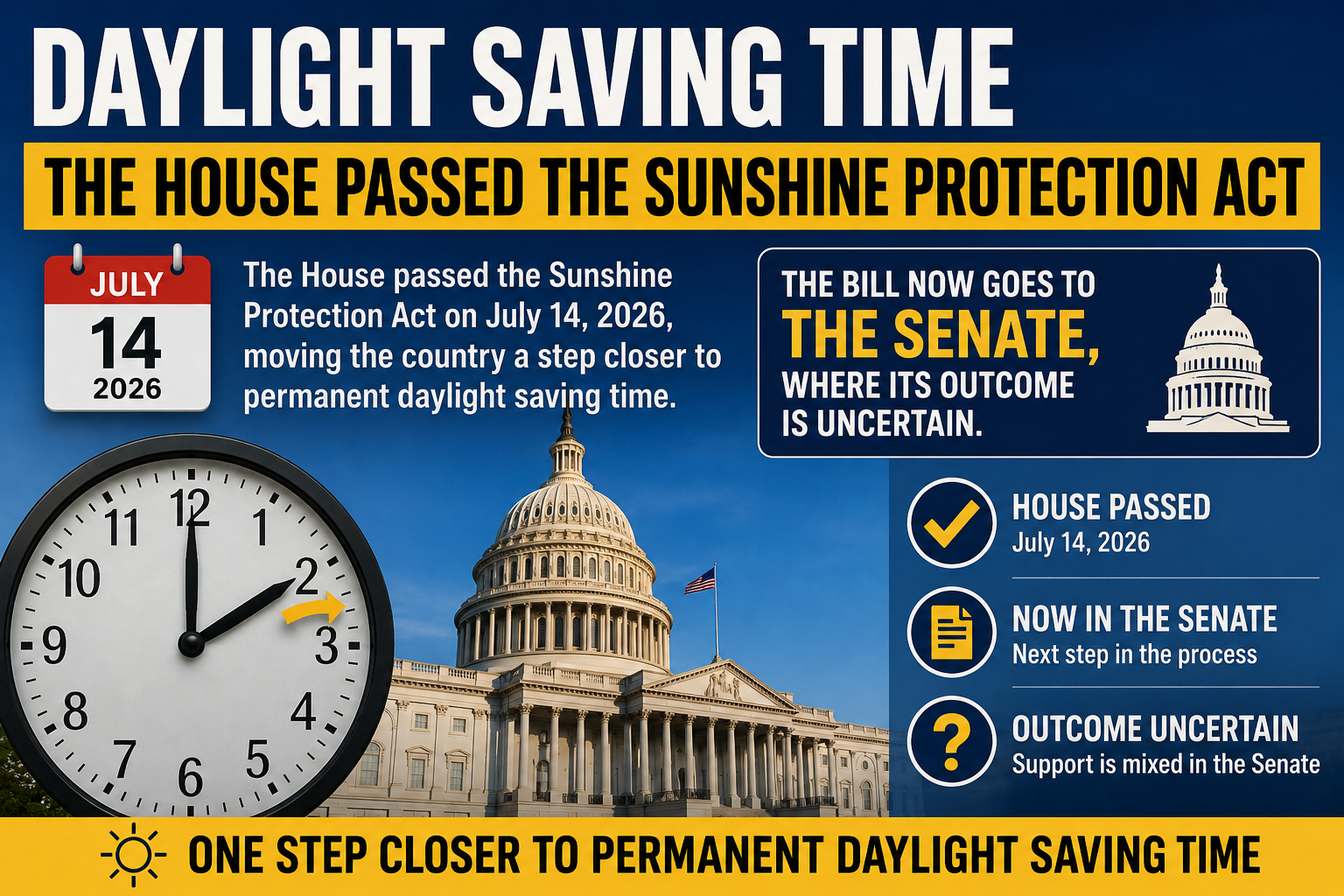
The House passed the Sunshine Protection Act on July 14, 2026, moving the country a step closer to permanent daylight saving time. The bill now goes to the Senate, where its outcome is uncertain.

What The Bill Does
The Sunshine Protection Act would end the twice-yearly clock change and keep the country on daylight saving time all year. This is the same time currently observed from March to November. States would be allowed to exempt themselves before the law takes effect, according to NBC News. NBC News
How The House Vote Went
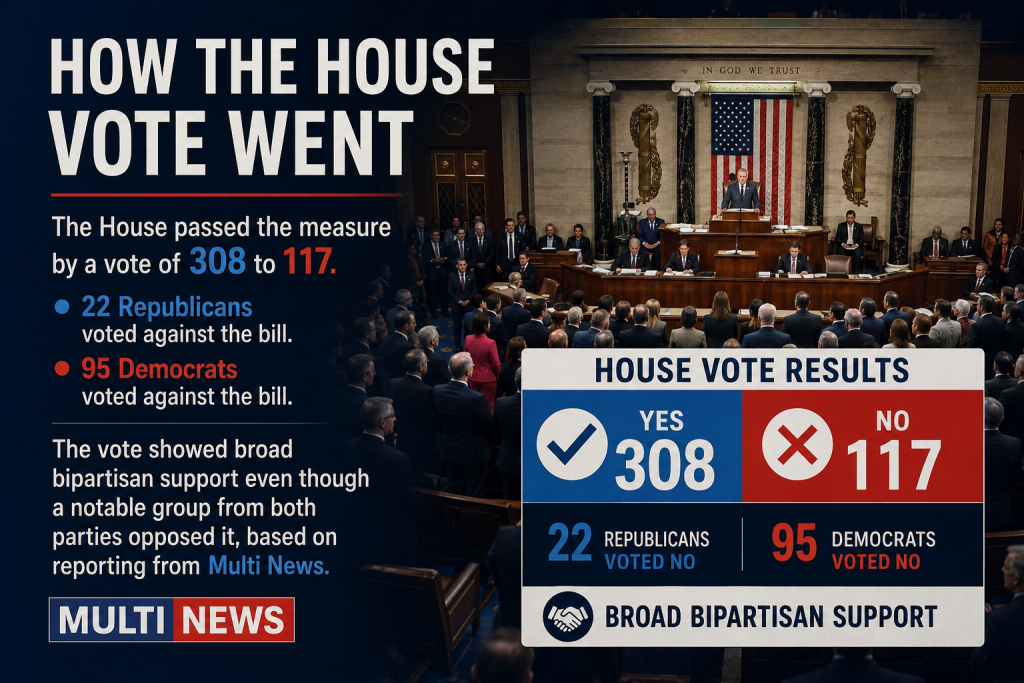
The House passed the measure by a vote of 308 to 117. Twenty-two Republicans and 95 Democrats voted against the bill. The vote showed broad bipartisan support even though a notable group from both parties opposed it, based on reporting from The Hill. The HillThe Hill
Who Introduced And Backed The Bill
The bill was championed in the House by Congressman Brett Guthrie, Chairman of the House Committee on Energy and Commerce, along with Congressman Gus Bilirakis and Congressman Vern Buchanan. President Trump has publicly backed the legislation. He said in a Truth Social post that the twice-yearly clock change costs Americans, cities, and states hundreds of millions of dollars each year, according to The Hill. The White House also sent an internal memo to Capitol Hill offices urging lawmakers to support the bill, calling it a common-sense reform, based on reporting from Fox News. House Passes Legislation to Make Daylight Saving Time Permanent +2
Why Some Lawmakers Oppose It
Opponents raise concerns about darker mornings in winter. In some parts of the country, the sun would not rise until after 9 a.m. under permanent daylight saving time. Critics point to safety risks during dark morning commutes and challenges for farmers who would need to start work later in the day, according to Fox News. Representative Mary Gay Scanlon of Pennsylvania argued that permanent daylight saving time would create health and safety risks for children, who would go to school during darker morning hours. Fox NewsFox News
Country Star Zach John King Canceled Two Weeks of Concerts Following Father’s Sudden Death
Country singer Zach John King has Canceled two weeks of scheduled concerts after his father, John King, died suddenly on July 10, 2026. What…

What Happens Next In The Senate
The bill now moves to the Senate, where its path is unclear. A similar Senate effort stalled last year after Senator Tom Cotton of Arkansas objected to fast-tracking the bill through unanimous consent. Cotton had cited concerns about dark morning commutes and workers needing to start early without sunlight, and a Senate aide said Cotton still holds the same concerns. Several senators from both parties have also opposed the Senate version of the bill in committee, according to NBC News. House passes Trump-backed bill that would make daylight saving time permanent +3

A History Of Failed Attempts
This is not the first time Congress has tried to make daylight saving time permanent. Congress adopted a similar measure in 1974 during the energy crisis, but lawmakers reversed course quickly after it became deeply unpopular. In 2022, the Senate passed a version of the bill, but it never received a floor vote in the House. In 2025, a bipartisan group of senators tried to pass a similar measure through unanimous consent, but Senator Cotton blocked it, based on reporting from CNN. House passes bill to make Daylight Saving Time permanent | CNN Politics +3
What Would Change If It Becomes Law
If the Senate passes the bill and the president signs it, Americans would stop changing their clocks twice a year. The country would stay on the time currently used during daylight saving months, meaning later sunsets year round but also later sunrises in winter.
| Step | Status |
|---|---|
| House vote | Passed, 308 to 117 |
| Senate vote | Not yet scheduled |
| Presidential signature | Pending Senate approval |
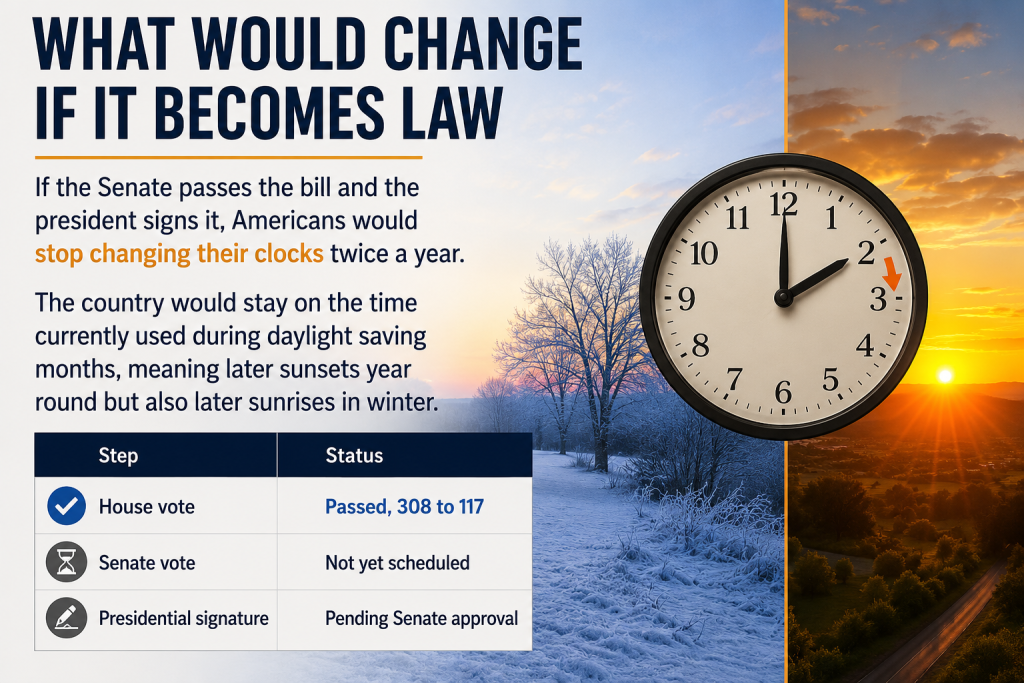
This table reflects the bill’s status as of publication, based on details from Multi News.
FAQ: Daylight Savings Bill Passes House | What Happens Next in the Senate
Q: What did the House actually vote on?
Q: What was the final vote count?
Q: Was this a bipartisan vote?
Yes. The legislation divided lawmakers in both parties, with members largely from coastal areas, such as Louisiana, Florida and New Jersey, supporting permanent daylight saving time and others from the Midwest and agriculture-heavy states opposing it. Democrats were nearly evenly split, with House Minority Leader Hakeem Jeffries opposing it.
Q: Does President Trump support the bill?
Q: What happens now that it’s passed the House?
Q: Has the Senate dealt with this issue before?
Yes. The Senate unanimously approved a similar measure in 2022, which stalled in the House, but it could face some opposition in the upper chamber this time around. More recently, a bipartisan group of senators in 2025 sought unanimous consent to pass a similar measure, but were thwarted by Republican Sen. Tom Cotton of Arkansas.
Q: Why might the Senate reject or stall the bill?
Q: Would every state be forced to switch?
Q: How many states are already prepared for the change?
Q: What’s the argument in favor of permanent daylight saving time?
Q: What’s the argument against it?
Q: When would the change take effect if signed into law?
The Write doesn’t specify an exact effective date beyond noting states can opt out “before it takes effect.” I’d recommend checking the bill text directly or a follow-up report for the precise timeline once the Senate acts.