











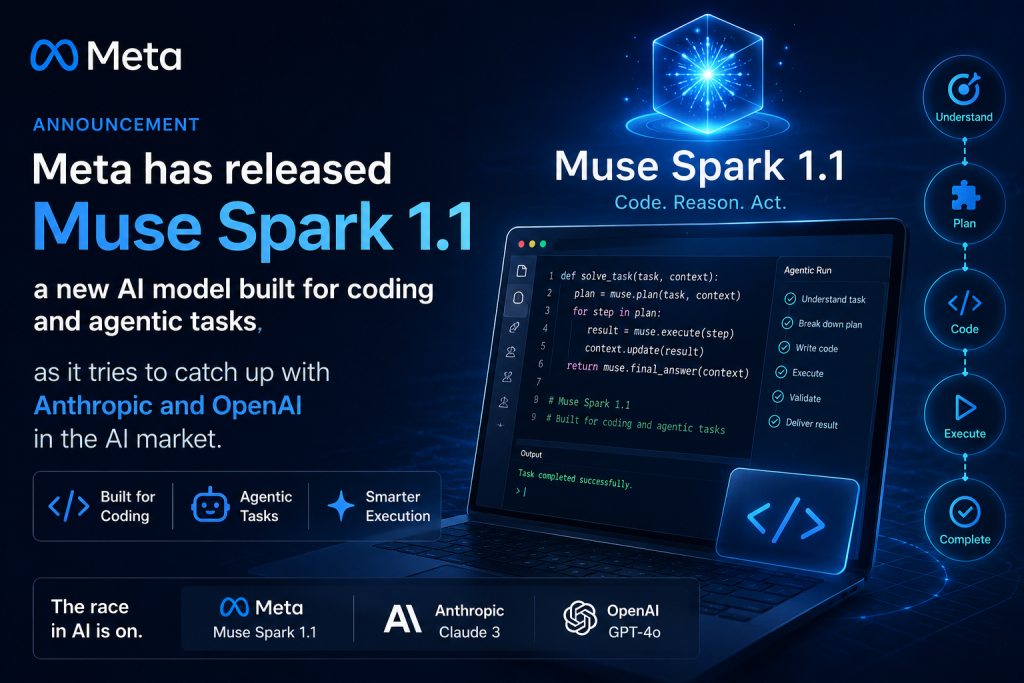
Meta has released Muse Spark 1.1, a new AI model built for coding and agentic tasks, as it tries to catch up with Anthropic and OpenAI in the AI market.

What Meta Announced
Meta introduced Muse Spark 1.1 on July 9, 2026. The company called it its strongest model yet for coding and agentic work. This update comes just three months after Meta released its first model under new AI chief Alexandr Wang. (CNBC)
The earlier version of Muse Spark launched in April. At that time, only select partners could use it through a private preview. Meta has now opened access more widely through a public developer portal. (CNBC)
El Niño Forecast 2026: Latest Updates, Trends & What to Expect
El Niño conditions are active in 2026 and expected to strengthen through the rest of the year, according to NOAA’s Climate Prediction Center. Current…
Public Access Through the Meta Model API
Meta is launching a public preview of a new Meta Model API. Developers can sign up through this portal and follow instructions to connect the model to their own tools. Some early partners already have access, and new users can join a waitlist. (Meta AI Blog)
Every new API account starts with 20 dollars in free credits. Wang described the pricing as aggressive compared with similar offers from Anthropic and OpenAI. (CNBC)
Why Meta Is Focusing on Coding
Wang said Meta trained Muse Spark 1.1 to be strong at coding because this skill supports broader agentic capabilities. He compared future AI agents to a fleet of human interns that can handle multiple tasks on their own. (CNBC)
The model was also built to work with popular developer tools already in use today. Meta made this choice to increase adoption among developers who already rely on existing coding setups. (CNBC)
This marks a shift in Meta’s AI strategy. The company built its reputation on open-source Llama models. Now it is focusing more on selling access to proprietary models instead. (CNBC)
Key Capabilities of Muse Spark 1.1
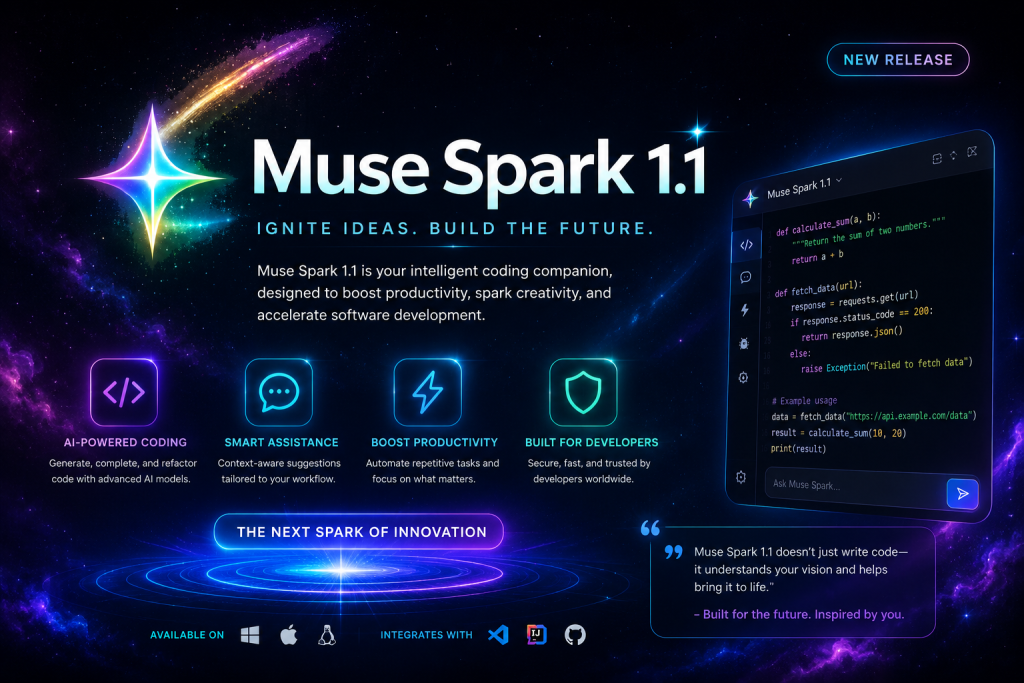
Muse Spark 1.1 is a multimodal reasoning model. It shows major improvements in tool use, computer use, coding, and multimodal understanding. Meta says these gains move the model further along what it calls the performance efficiency frontier. (Meta AI Blog)
The model can inspect images and audio, keep track of details across long workflows, and use that information to operate computers on a person’s behalf. Meta highlighted an example where the model builds a Facebook Marketplace listing using video captured from a phone. (Meta AI Blog)
In another internal demo, the model built a chat web app, took automated screenshots to find bugs, traced the issues back to the code, and fixed them. Meta said this shows how the model blends coding, multimodal understanding, and tool calling together. (Meta AI Blog)
The model is now available in Thinking mode inside the Meta AI app. Meta said its own researchers and developers already use Muse Spark 1.1 daily to speed up their work. (Meta AI Blog)
How Muse Spark Compares With Rivals
Meta has been working to close the coding gap with OpenAI and Anthropic for months. The earlier Muse Spark model scored 52.5 percent on SWE-Bench Pro, a widely used coding benchmark. GPT-5.5 scored 58.6 percent on the same test and also performed better on Terminal-Bench 2.0. (SiliconANGLE)
Claude Opus 4.8 from Anthropic scored 69.2 percent on SWE-Bench Pro, which was 10.2 percentage points higher than GPT-5.5 at the time. However, GPT-5.5 still performed better than Claude Opus 4.8 on Terminal-Bench 2.0. (SiliconANGLE)
| Model | SWE-Bench Pro Score | Notable Strength |
|---|---|---|
| Muse Spark (original) | 52.5% | Early agentic coding baseline |
| GPT-5.5 (OpenAI) | 58.6% | Strong on Terminal-Bench 2.0 |
| Claude Opus 4.8 (Anthropic) | 69.2% | Leading coding benchmark score |
Wang said Meta’s newer model would be significantly better at coding than the original Muse Spark. He also said the company is training an even more advanced model, currently code-named Watermelon, though no release date has been shared. (CNBC)
Business Pressure Behind the Push
Meta CEO Mark Zuckerberg faces pressure from investors to show returns on the company’s heavy AI spending. Unlike some competitors, Meta does not yet run its own cloud infrastructure business, though it has plans to start one. (CNBC)
Meta has also been expanding its AI product lineup beyond coding. Earlier the same week, it released Muse Image, a model for generating images, aimed at creators and advertisers. (CNBC)
Wider Push Toward AI Assisted Development
Meta has set internal targets pushing engineers toward heavier AI use in daily coding work. Some engineering teams are being asked to generate more than 75 percent of their committed code using AI tools during 2026. (Blockchain Council)
Company-wide, Meta has aimed for a majority of software engineering changes to become agent assisted, alongside high adoption of general AI tools among mid and senior level engineers. This reflects how central AI has become to Meta’s internal engineering culture, not just its public products. (Blockchain Council)
Meta has also released tools aimed at helping AI coding agents work more reliably with its own software. In June 2026, the company open sourced Astryx, a React design system built internally over eight years, giving AI agents a structured way to read and use its components. (Tech Times)
FAQ: Meta’s Muse Spark 1.1 AI Model
Q: What is Muse Spark 1.1?
A: It’s Meta’s newest AI model, built for coding and agentic tasks — meaning it can plan, use tools, and carry out multi-step actions with less human input. Meta Superintelligence Labs released it as an updated multimodal reasoning model with reported improvements in tool use, computer use, coding, and multimodal understanding. StreetInsider
Q: Why did Meta release this model?
A: Meta launched Muse Spark 1.1 as a multimodal AI model designed for agentic coding that aims to compete with similar products offered by OpenAI and Anthropic. The company is behind rivals, who have offered similar models for a while, but Meta’s entry still represents a competitive threat. TechCrunchTechCrunch
Q: What can Muse Spark 1.1 actually do?
A: It performs well with popular agentic coding setups, supporting features like planning mode, goal conditioning, subagent delegation, and context compaction. It supports a context window of one million tokens and is built to orchestrate multi-agent systems, functioning as both a primary agent and a subagent, with the ability to delegate tasks across parallel subagents to reduce latency. On the coding side, it shows major improvements on real-world tasks involving large, complex codebases, including diagnosing and fixing bugs, implementing new features in enterprise systems, and executing large-scale code migrations. Meta + 2
Q: How much does it cost to use?
A: Meta is charging $1.25 per million input tokens and $4.25 per million output tokens, putting it roughly in line with — though slightly above — Anthropic’s Claude Haiku 4.5 and OpenAI’s cheaper models. New developers also get $20 in free credits to test the model before switching to pay-as-you-go pricing. TechCrunchRepublic World
Q: Where can people access it?
A: The model is available in “Thinking” mode in the Meta AI app and on meta.ai, and Meta has launched a public preview of a new Meta Model API giving developers access for the first time. For now, Meta is limiting API access to its own infrastructure rather than making it available on third-party platforms like OpenRouter. Early API partners include Replit, Cline, and Box. StreetInsider + 2
Q: How does it compare to Anthropic’s and OpenAI’s models?
A: It is not a coding-accuracy leader — Opus 4.8 and GPT-5.5 beat it there — but it tops professional and scaled tool-use benchmarks, which matters for agents that run real tools. Meta is positioning it as a frontier-tier competitor to GPT-5.5, Claude Opus 4.8, and Gemini 3.1 Pro, though long-horizon agentic work remains a relative weakness compared to GPT-5.5 and Opus 4.8. Digital Applied TeamDataCamp
Q: Is this a big strategic shift for Meta?
A: Yes. Until now, Meta’s models reached developers mainly as open weights; with Muse Spark 1.1, Meta is charging for access to its own frontier model the way Anthropic and OpenAI do — a strategic pivot as much as a product launch. Unlike the open Llama family, Muse Spark 1.1 is proprietary and closed-weight, meaning no local deployment or community fine-tuning. Digital Applied TeamDataCamp
Q: Is Meta working on anything bigger?
A: Yes — Meta is currently training a more powerful model code-named “Watermelon,” though the company hasn’t said when it will be released. CNBC