













A bipartisan group of senators has introduced the PROMISE Act, a bill designed to force Congress to vote on a Social Security solvency plan before the program’s trust fund runs out of money in 2032.

What The PROMISE Act Does
The bill’s full name is the Protecting Retirement Opportunities and Maintaining Income Security for Everyone Act. It creates a process that requires Congress to act on Social Security’s funding problem instead of continuing to delay it. The bill sets up an independent, bipartisan advisory committee that will study the issue and give Congress specific recommendations to fix it, according to ABC News. Washington Times
IBM Stock Price Today | Live Quote, Chart & Investment Insights
IBM shares dropped sharply today, falling around 23 to 24 percent after the company issued a weak preliminary second-quarter earnings warning. What Happened To…

Why Lawmakers Introduced This Bill Now
The bill comes right after the Social Security Board of Trustees released its newest annual report. That report moved up the projected shortfall date to 2032, one year earlier than what was projected the year before, according to US News. The trustees also found that Social Security may only be able to pay 78% of scheduled retirement benefits once the shortfall hits, based on reporting from CNBC. U.S. News & World ReportCNBC
Who Is Behind The Bill
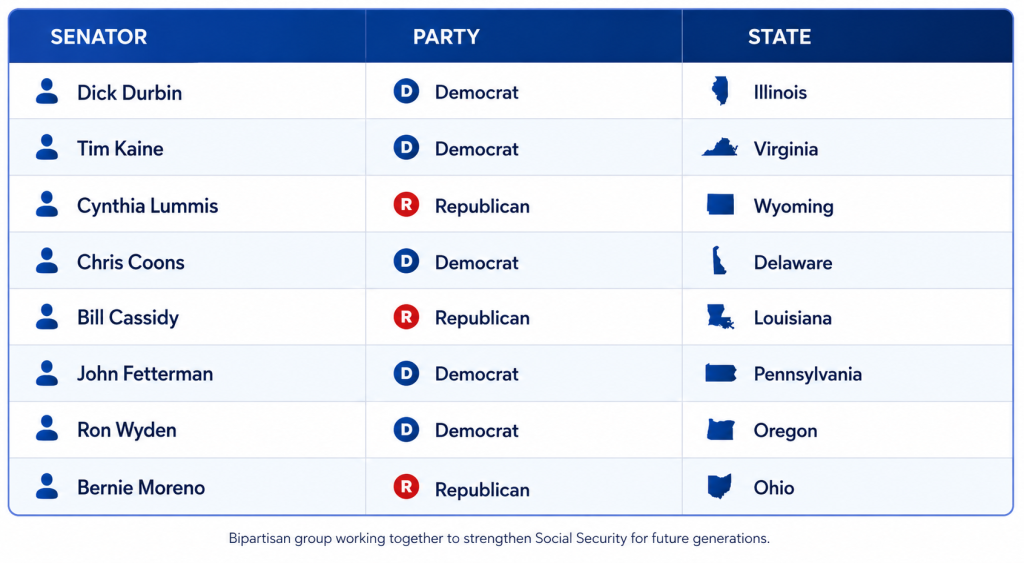
The bill has support from senators on both sides of the aisle. Democratic Senator Dick Durbin of Illinois is one of the bill’s authors, along with Democratic Senator Tim Kaine of Virginia and independent Senator Angus King of Maine. Republican Senators Bill Cassidy of Louisiana, John Cornyn of Texas, and Thom Tillis of North Carolina are also backing the bill, according to Washington Times. Senators Chris Coons of Delaware and Alan Armstrong of Oklahoma signed on right before the bill’s introduction. Washington Times
| Senator | Party | State |
|---|---|---|
| Dick Durbin | Democrat | Illinois |
| Tim Kaine | Democrat | Virginia |
| Angus King | Independent | Maine |
| Chris Coons | Democrat | Delaware |
| Bill Cassidy | Republican | Louisiana |
| John Cornyn | Republican | Texas |
| Thom Tillis | Republican | North Carolina |
| Alan Armstrong | Republican | Oklahoma |
Why Congress Has Waited This Long
Social Security’s funding problem has been known for years, but Congress has avoided acting on it. Cutting benefits or raising taxes to fix the program has long been politically unpopular, so lawmakers have repeatedly pushed the problem to future sessions of Congress, according to Washington Times. Senator Durbin, who is retiring, said the longer Congress waits, the harder the problem becomes to solve, based on his statement reported by ABC News. Washington TimesABC News
Other Ideas On The Table
This bill is not the only proposal aimed at Social Security’s funding gap. Last month, Senators Elizabeth Warren and Bernie Moreno wrote an op-ed calling for raising the cap on the Social Security payroll tax. For 2026, that cap sits at $184,500, meaning income above that amount is not taxed for Social Security, according to US News. That idea faced strong pushback from conservative groups, including Americans for Tax Reform. U.S. News & World Report
What Happens If Congress Does Nothing
If no funding solution passes before 2032, benefit payments could be automatically reduced under current law. Some economists warn that a looming depletion date could also create risks for the bond market and broader economy if it goes unresolved, according to CNBC. The PROMISE Act does not fix the funding gap itself. Instead, it sets up a process meant to guarantee that Congress votes on an actual solvency plan rather than continuing to delay action. CNBC
FAQ: Bipartisan Social Security Legislation
Q: What is the bipartisan Social Security legislation currently being proposed?
The bipartisan Social Security legislation refers to a bill introduced by a group of senators from both parties aimed at addressing the program’s projected funding shortfall. The legislation typically includes proposals related to trust fund solvency, benefit adjustments, or revenue changes to keep the program funded long-term.
Q: Why is bipartisan Social Security legislation needed right now?
Social Security’s trust funds are projected to face a shortfall in the coming years, which could lead to automatic benefit cuts if Congress doesn’t act. Bipartisan legislation is being introduced to find a solution that both parties can agree on before the shortfall hits.
Q: Which senators are behind this bipartisan Social Security legislation?
This depends on the specific bill in question — bipartisan Social Security proposals are usually co-sponsored by senators from both the Democratic and Republican parties, often including members from Senate committees overseeing finance or aging-related policy.
Q: How would this legislation affect current Social Security beneficiaries?
The specific impact depends on what’s in the bill — some proposals focus on protecting current benefits while adjusting funding sources (like payroll tax caps), while others include phased changes for future retirees. Most bipartisan efforts aim to avoid disrupting benefits for people already receiving them.
Q: When could this bipartisan Social Security legislation take effect?
Bipartisan bills typically go through committee review, potential amendments, and votes in both the House and Senate before becoming law — a process that can take months or longer, depending on political priorities and negotiations.
Q: What happens if Congress doesn’t pass Social Security legislation before the shortfall?
If no legislation passes before the trust fund shortfall date, Social Security could face automatic, across-the-board benefit reductions — which is a major reason lawmakers from both parties are pushing to act now.