












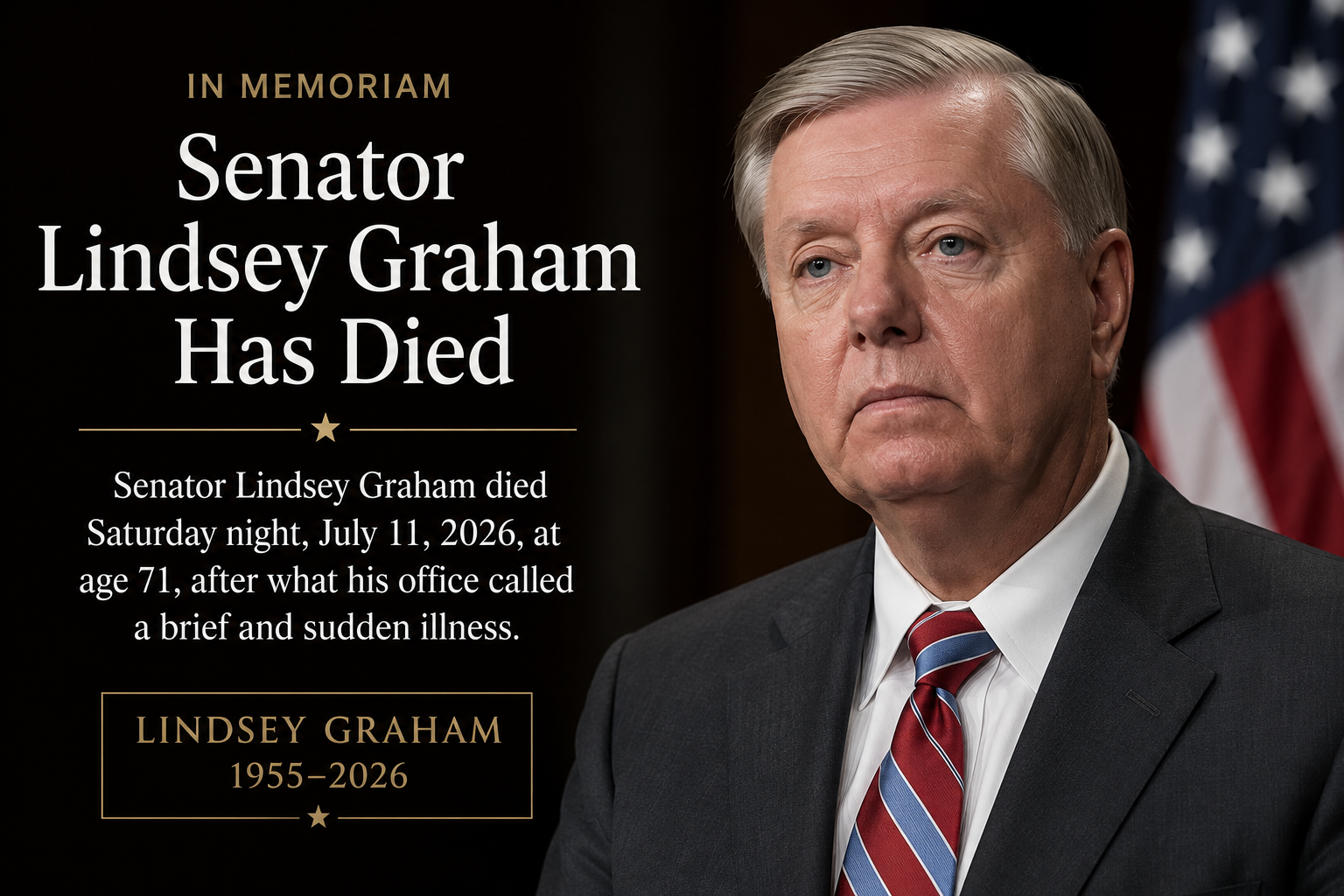
Senator Lindsey Graham died Saturday night, July 11, 2026, at age 71, after what his office called a brief and sudden illness.

How Graham Death Was Announced
Graham office confirmed his death early Sunday morning through a statement from his communications director. The statement said Graham died Saturday night and asked for privacy for his family during this time, according to NBC News.
Graham Final Days In Office
A top staffer told reporters there was no sign Graham was unwell before his death. He had been scheduled to appear on Meet the Press on Sunday morning, a show he had appeared on 63 times over the years, based on reporting from NBC News. Just two days earlier, Graham had met with Ukrainian President Volodymyr Zelenskiy in Kyiv, according to Reuters.

Reaction From Political Leaders
President Donald Trump led tributes to Graham on Sunday, calling him one of the greatest senators he had ever known and a true American patriot, according to NBC News. Senate Majority Leader John Thune praised Graham as a strong advocate for the United States, while South Carolina Governor Henry McMaster called him the fiercest of fighters for South Carolina and America, based on reporting from The Washington Post. Democratic nominee Annie Andrews, who was set to face Graham in November, also offered condolences and called for setting partisanship aside, according to Fox Carolina.
Ann Widdecombe Death | 26-Year-Old Man Held on Suspicion of Murder
Ann Widdecombe, the former UK government minister and Reform UK politician, was found dead at her home on Thursday, and police have arrested a…

Graham Career In The Senate
Graham was first elected to the Senate in 2002 and became a leading Republican voice on defense and foreign policy. He served as chairman of the Senate Budget Committee and had secured the Republican nomination for a fifth term in South Carolina’s June 9 primary, according to Newsweek.

What Happens To Graham Senate Seat
Under South Carolina law, Governor McMaster can appoint a temporary replacement to serve until January 3 following the next general election. This appointment does not automatically make that person the Republican nominee for the November race, according to CNN.
Timeline For The Special Election
A separate legal process will decide the Republican nominee for November. The filing period for candidates opens July 21 and closes July 28. A special primary is scheduled for August 11, with a runoff on August 25 if no candidate wins a majority. The winner will face Democratic nominee Annie Andrews in the general election, based on reporting from Newsweek.
Impact On The Senate
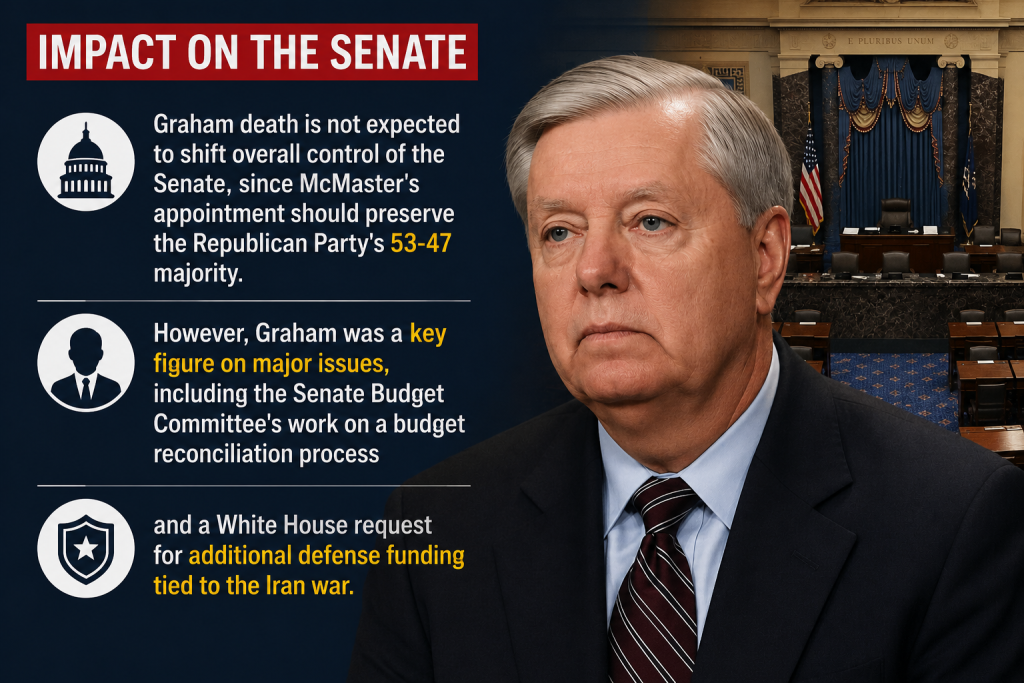
Graham death is not expected to shift overall control of the Senate, since McMaster’s appointment should preserve the Republican Party’s 53-47 majority. However, Graham was a key figure on major issues, including the Senate Budget Committee’s work on a budget reconciliation process and a White House request for additional defense funding tied to the Iran war, according to CNN.
FAQ: Lindsey Graham — News Today, Statements, Votes, and Senate Updates
Q: What is the latest news about Lindsey Graham?
Q: What happens to his Senate seat now?
A: Under South Carolina law, Governor Henry McMaster can appoint a temporary replacement to fill Graham’s vacant seat. Because Graham was up for reelection this year, his death triggers a sprint primary election, with state law appearing to call for a special primary on August 11, a possible runoff on August 25, and candidate filing running from July 21 to July 28. The primary winner would face Democratic nominee Annie Andrews, a pediatrician, in November.
Q: Will his death shift the balance of power in the Senate?
A: Graham’s death is not expected to have a short-term impact on the overall balance of power, since McMaster is a Republican and his appointment should restore the 53-47 GOP majority. However, Graham chaired the Senate Budget Committee, which was in the early stages of working through a complex budget reconciliation process, and he was expected to be a key voice on pending defense funding requests tied to the Iran war and on Acting Attorney General Todd Blanche’s confirmation before the Judiciary Committee.
Q: What were his most recent legislative actions before his death?
A: Graham sponsored the Secure America Act (S.2), which became Public Law No. 119-98 on June 10, 2026, after passing the Senate 52-47 and the House 214-212. He also co-wrote a Russia sanctions bill with Senator Richard Blumenthal that would allow tariffs and secondary sanctions on countries buying Russian oil, gas, and other exports, which he said Trump had “greenlit.”