












Mark Cuban believes every employee, from the janitor to the CEO, should own a piece of the company they work for. He wants stock ownership tied to pay level for everyone on the payroll, not just executives.

What Cuban Said On The Podcast
Cuban made his case on a recent episode of the “What It Takes” podcast. He said he wants every founder and entrepreneur to follow the same path he took, which was giving equity to every employee at his companies. AOL
Cuban framed employee ownership as a direct answer to income inequality. He said giving workers shares in the company they help build lets them benefit financially, the same way owners and executives do. Fortune
The CEO To Janitor Example
Cuban used a simple example to explain his idea. If a CEO earns $1 million in cash and receives stock worth 10% of that amount, a janitor earning $50,000 should receive the same 10% share, or $5,000 in stock. Yellow
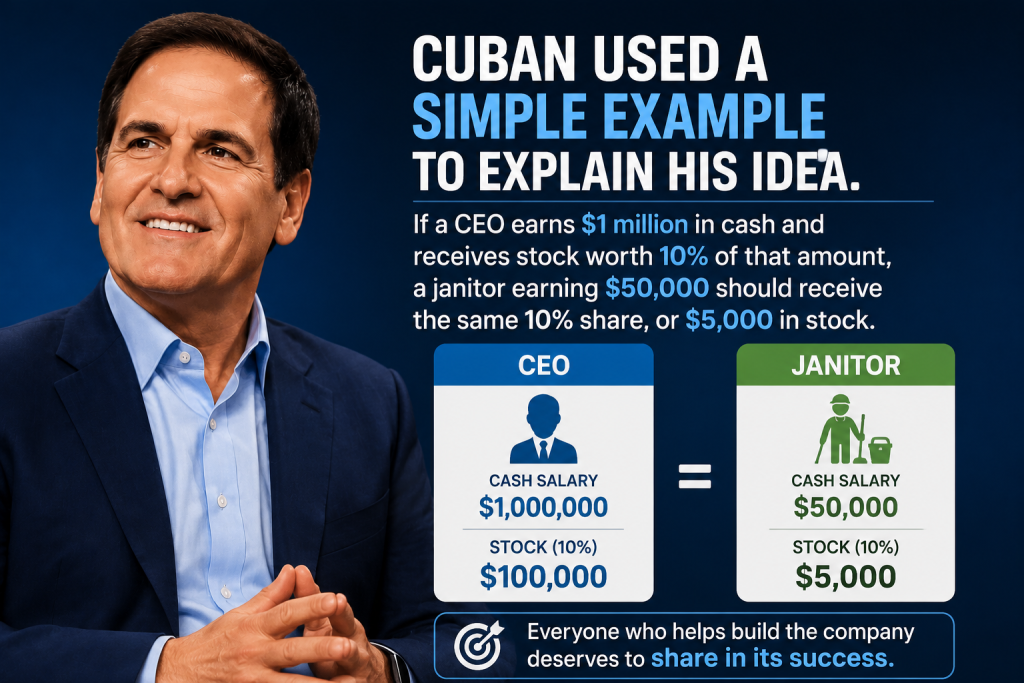
Cuban said that matching the stock percentage across pay levels, rather than matching dollar amounts, is what makes the model fair. Everyone gets the same proportional stake in the company’s future value. All Blog Things
The Tax Code Proposal
Cuban wants the federal tax code to reward companies that follow this model. Under his plan, firms that give every employee the same stock percentage as their CEO would keep the standard 21% corporate tax rate. WDC TV News
Companies that choose not to share equity proportionally would lose that lower tax rate and pay more, under Cuban proposal. He argues this gives businesses a clear financial reason to adopt the practice. AOL
Kaylee Hottle, ‘Godzilla Vs. Kong’ Actress, Dies At 18 – Deaf Community Mourns
Kaylee Hottle, the deaf actress known for playing Jia in the “Godzilla vs. Kong” films, has died at age 18 after a car crash…

Sample Stock Distribution Under Cuban Model
| Role | Cash Salary | Stock Percentage | Stock Value |
|---|---|---|---|
| CEO | $1,000,000 | 10% | $100,000 |
| Janitor | $50,000 | 10% | $5,000 |
Cuban Own Track Record With Employee Equity
Cuban has applied this approach in businesses he built and sold. When he sold Broadcast.com to Yahoo in 1999 in a deal valued at $5.7 billion, employees holding stock and options shared in the payout. Yellow
Reports from that sale say about 300 of Broadcast.com’s 330 employees became millionaires through their equity stakes. Cuban has pointed to that outcome as proof his approach works in practice. Entrepreneur
A Long Standing Position, Not A New One
Cuban has raised this idea publicly for years, not just on the recent podcast. In an earlier post on social media, he asked why more companies do not give stock to all employees at the same percentage of cash earnings given to executives. Entrepreneur
How This Compares To Other Executives
Cuban comments followed similar remarks from Elon Musk after SpaceX’s public listing. Musk said he has always wanted employees to share in the upside of the companies he runs, echoing the same ownership principle. AOL
One SpaceX example often cited alongside Cuban proposal involves a former welder who joined the company in 2015 earning $28 an hour. His equity stake was reported to be worth close to $880,000 after the company’s public listing. WDC TV News
What Research Says About Employee Ownership
Cuban proposal lines up with earlier academic research on broad based employee ownership. A 2021 Harvard Business School study using government data looked at what would happen if all private firms in the US adopted employee ownership more widely. Fortune
FAQ: Mark Cuban Stock Options Philosophy
Q1: What is Mark Cuban stock options philosophy?
Mark Cuban believes every employee — from the CEO down to the janitor — should receive a proportional equity stake in the company they help build. Rather than treating stock options as a perk reserved for executives and top performers, Cuban argues ownership should be distributed across the entire workforce.
Q2: Why does Mark Cuban support giving equity to all employees?
Cuban is a firm believer in what he calls “compassionate capitalism.” He argues that wages alone cannot solve income inequality because salaries only cover current living expenses and don’t build long-term wealth. Equity, on the other hand, gives employees a stake in the company’s future growth and success.
Q3: How does Mark Cuban philosophy address income inequality?
His argument is that traditional pay structures keep workers dependent on paychecks without ever building assets. By giving employees ownership through stock options, Cuban believes companies can help close the wealth gap, since equity can appreciate over time and create real financial upside beyond a regular salary.
Q4: What does “compassionate capitalism” mean in Cuban philosophy?
“Compassionate capitalism” is the term Cuban uses to describe a business approach that combines profit-seeking with genuine concern for employee wellbeing. It suggests companies can remain competitive and profitable while still prioritizing fair, long-term financial benefits for every worker.
Q5: Does Mark Cuban philosophy apply only to tech or startup companies?
No – the philosophy is framed as a universal principle applicable to any company, regardless of industry. Cuban point is that any employee who contributes to a company’s success, whether in a corner office or on the ground floor, deserves a proportional share of the value they help create.
Q6: How is this different from typical stock option plans at most companies?
Traditional stock option plans are usually reserved for executives, senior management, and select high performers. Cuban philosophy pushes for a more egalitarian model where equity is extended broadly across all roles and pay levels, not just top earners.
Q7: What’s the main criticism or challenge to Cuban approach?
Critics might point out that broad-based equity distribution can dilute shares significantly, create complex valuation and vesting structures, and may not suit companies with thin margins or non-scalable business models. Implementing proportional equity for every employee also requires significant administrative and legal planning.
Q8: Has Mark Cuban implemented this philosophy in his own businesses?
Cuban has spoken publicly about this philosophy as part of his broader views on capitalism and worker compensation, often in interviews and public commentary on economic inequality, though the specifics of implementation vary by venture and company.