












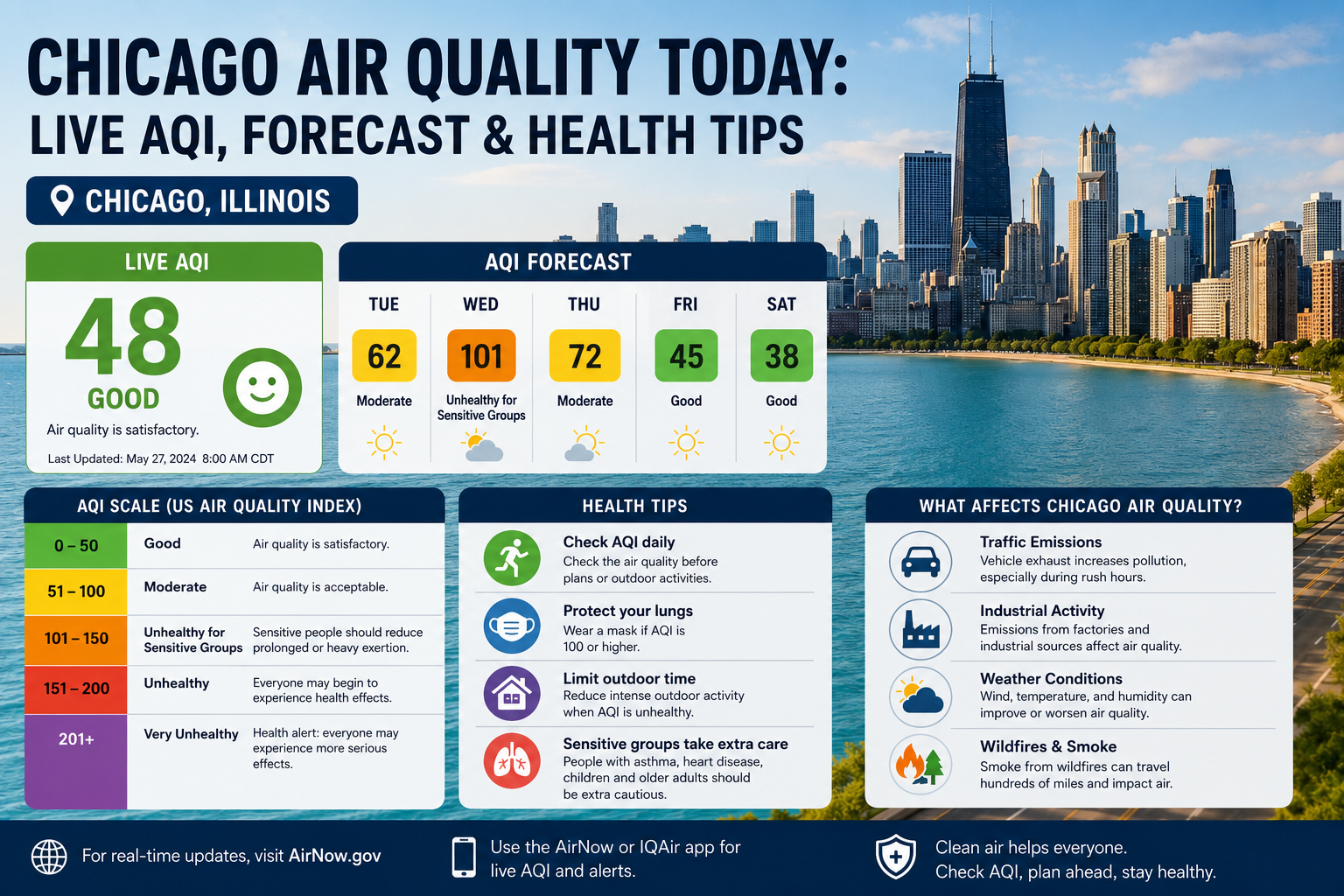
Chicago’s current air quality index (AQI) is tracked in real time. The Illinois EPA uploads data to AirNow so the latest AQI is always available. Today’s AQI reflects local traffic and industry emissions plus weather effects such as heat or wind.

Current AQI in Chicago
Chicago’s AQI varies by hour and season. In 2019 the city’s average AQI was 52 (Moderate), but summer ozone spikes can push it higher. Hot, sunny weather drives ground-level ozone (a smog pollutant) by reacting with vehicle and industrial emissions. Wildfire smoke from distant fires can also blow into the region and raise particle levels, causing brief unhealthy conditions. Citizens should check the live AQI (for example, on the AirNow website or app) to see current conditions.
Factors Affecting Air Quality
Sensors across Chicago monitor pollutants like fine particles (PM2.5) and nitrogen dioxide (NO₂) around the clock. These come mainly from cars, trucks, and factories. On hot summer days, sunlight and heat react with these emissions to form ozone (smog). Higher temperatures and climate change are making these smog events more common. As one report notes, even on clear summer days smoky haze from wildfires or local pollution can make AQI unhealthy. For example, Chicago’s AQI can go from Good to Unhealthy in a matter of hours if ozone peaks or smoke blows in.
Roger Rogoff Trump Administration Dismissal | Seattle US Attorney Fired in Under an Hour
Roger Rogoff was fired by President Trump less than an hour after federal judges swore him in as U.S. Attorney for the Western District…

Air Quality Forecast for Chicago
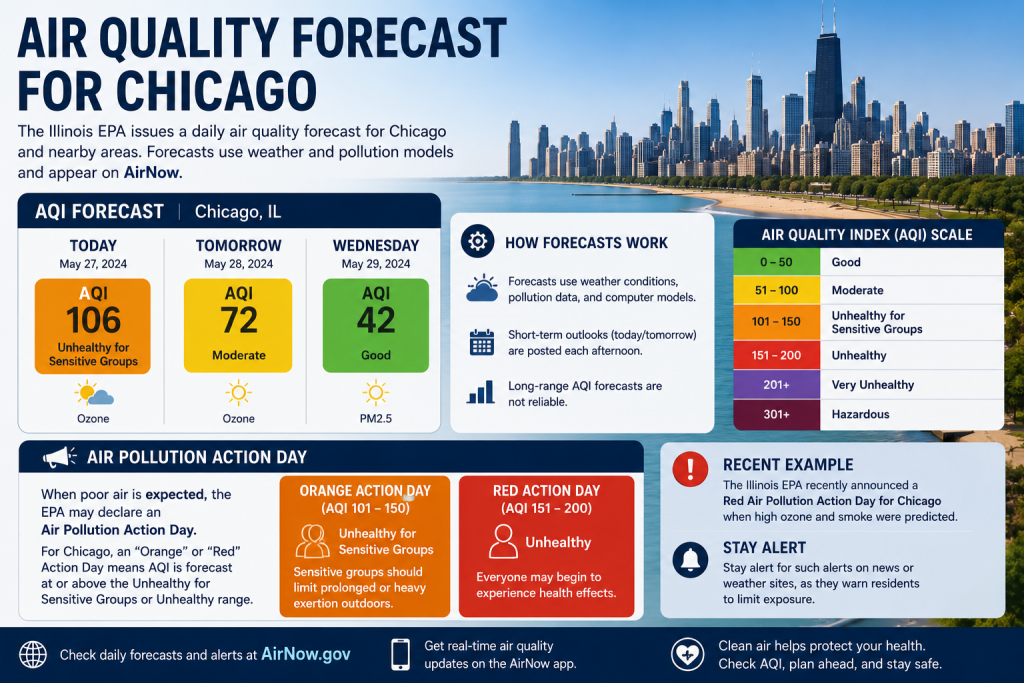
The Illinois EPA issues a daily air quality forecast for Chicago and nearby areas. Forecasts use weather and pollution models and appear on AirNow. Long-range AQI forecasts are not reliable, but short-term outlooks (today/tomorrow) are posted each afternoon. When poor air is expected, the EPA may declare an Air Pollution Action Day. For Chicago, an “Orange” or “Red” Action Day means AQI is forecast at or above the Unhealthy for Sensitive Groups or Unhealthy range. For example, the Illinois EPA recently announced a Red Air Pollution Action Day for Chicago when high ozone and smoke were predicted. Stay alert for such alerts on news or weather sites, as they warn residents to limit exposure.
AQI Categories and Health Guidelines
The AQI runs from 0 to 500, divided into categories with color codes. EPA defines 0–50 as Good (green, little or no health risk), 51–100 Moderate (yellow, acceptable air), 101–150 Unhealthy for Sensitive Groups (orange), 151–200 Unhealthy (red), 201–300 Very Unhealthy (purple), and 301+ Hazardous (maroon). Each jump above 100 signals greater health concern. Sensitive groups include people with lung or heart disease, older adults, children, and anyone with asthma or diabetes. The table below gives recommended actions for each AQI range (based on EPA guidance):
| AQI Level | AQI Range | Suggested Action |
|---|---|---|
| Good (Green) | 0–50 | Air is clean. Safe to be active outdoors. |
| Moderate (Yellow) | 51–100 | It’s okay for most people; unusually sensitive persons should reduce prolonged outdoor exertion. |
| Unhealthy for Sensitive (Orange) | 101–150 | Sensitive groups should limit time and intensity of outdoor activity; others take it easy. |
| Unhealthy (Red) | 151–200 | Everyone should reduce or reschedule long or heavy outdoor activities. |
| Very Unhealthy (Purple) | 201–300 | Everyone should avoid all strenuous outdoor exercise; sensitive individuals stay indoors. |
| Hazardous (Maroon) | 301–500 | Everyone: avoid any outdoor exertion; sensitive groups stay inside. |
For example, on a Moderate AQI day healthy people can still enjoy outdoor exercise, but those with asthma or heart conditions should take more breaks. When AQI moves into the Unhealthy range (red) or worse, the general public is warned to cut back on outdoor work or exercise. Check official sources (see below) to know today’s category.
- Who’s at risk: Children and older adults are especially vulnerable, as are anyone with breathing or heart problems. Even healthy adults should reduce exertion when AQI is above 150.
- Symptoms to watch: Coughing, wheezing, shortness of breath, or unusual fatigue can signal poor air quality effects. Take breaks indoors if you notice these.
How to Stay Informed and Protect Yourself
- Check Live AQI: Visit AirNow.gov or use the EPA’s AirNow mobile app for up-to-the-minute Chicago AQI readings.
- Sign Up for Alerts: Register for free EnviroFlash email or text alerts (Illinois uses EnviroFlash) to get daily forecasts and warnings. Local weather stations and apps often include AQI data, too.
- Limit Exposure: If AQI is in the Orange/Unhealthy or worse, avoid vigorous outdoor exercise. On hazy days, keep windows closed and use air conditioning or air purifiers to filter indoor air.
- Stay Healthy: Carry inhalers or medications if you have asthma or heart disease. Consult a doctor if you feel that pollution is affecting your breathing or health.
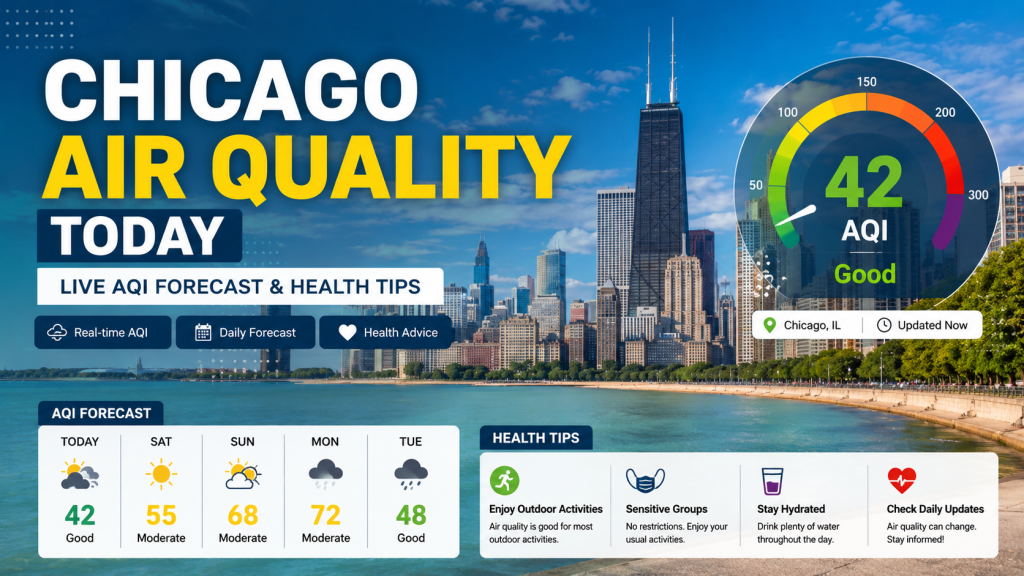
Being aware of Chicago’s live AQI, forecasts, and health advice will help you and your family plan safe outdoor activities. Always follow EPA/CDC guidance for your health category, and check official sources for the latest air quality updates.
Sources: EPA and Illinois EPA explain Chicago’s AQI monitoring and forecasts. The CDC and EPA provide AQI category definitions and health recommendations. Recent news and research (mid-2026) highlight summer ozone and wildfire smoke as key factors for Chicago air quality.
Simple Ways to Reduce Personal Exposure
- Check the AQI before planning outdoor exercise
- Exercise indoors on high-pollution days
- Use a HEPA air purifier at home
- Keep windows closed during ozone alerts
- Avoid busy roads during rush hour when walking or biking
- Wear a properly fitted N95 mask during smoke events
Long-Term Trends in Chicago’s Air Quality
Chicago’s air quality has generally improved over the past few decades due to stricter vehicle emission standards, cleaner industrial practices, and reduced coal use. However, ozone and particulate matter levels still rise during summer heat waves and wildfire smoke events, showing that air quality remains an ongoing public health concern.
Frequently Asked Questions
Q: What is the AQI in Chicago today?
AQI numbers vary by source and update hourly. Recent readings ranged from moderate to very unhealthy, with PM2.5 as the main pollutant across most monitors, according to Weather Underground. For the exact current number, check a live tracking site directly.
Q: Why do different websites show different AQI numbers for Chicago?
Each monitoring service uses its own mix of ground sensors, satellite data, and prediction models. This causes small to large differences between platforms at the same hour.
Q: What does “Very Unhealthy” AQI mean?
An AQI between 201 and 300 is labeled Very Unhealthy. At this level, health warnings apply to the entire population, not just sensitive groups, according to IQAir.
Q: What is the main pollutant affecting Chicago’s air quality?
PM2.5, or fine particulate matter, is usually the dominant pollutant in Chicago. These particles are small enough to enter the lungs and bloodstream and can worsen heart and lung conditions over time.
Q: Is it safe to exercise outdoors in Chicago right now?
This depends on the current AQI level. When AQI reaches Unhealthy or higher, it is best to reduce or avoid outdoor exercise, especially for children, older adults, and people with asthma or heart disease,
Q: Why is Chicago’s air quality often worse in summer?
Summer heat, higher traffic emissions, and wildfire smoke drifting in from other regions all contribute to seasonal spikes. Temperature inversions near Lake Michigan can also trap pollution closer to the ground,
Q: How often does Chicago’s AQI update?
Most tracking platforms update their readings hourly using live sensor and satellite data,
Q: Should I wear a mask outdoors during poor air quality days?
When AQI reaches Very Unhealthy or Hazardous levels, wearing an N95 mask outdoors is recommended, along with limiting time outside and running an air purifier indoors, according to