











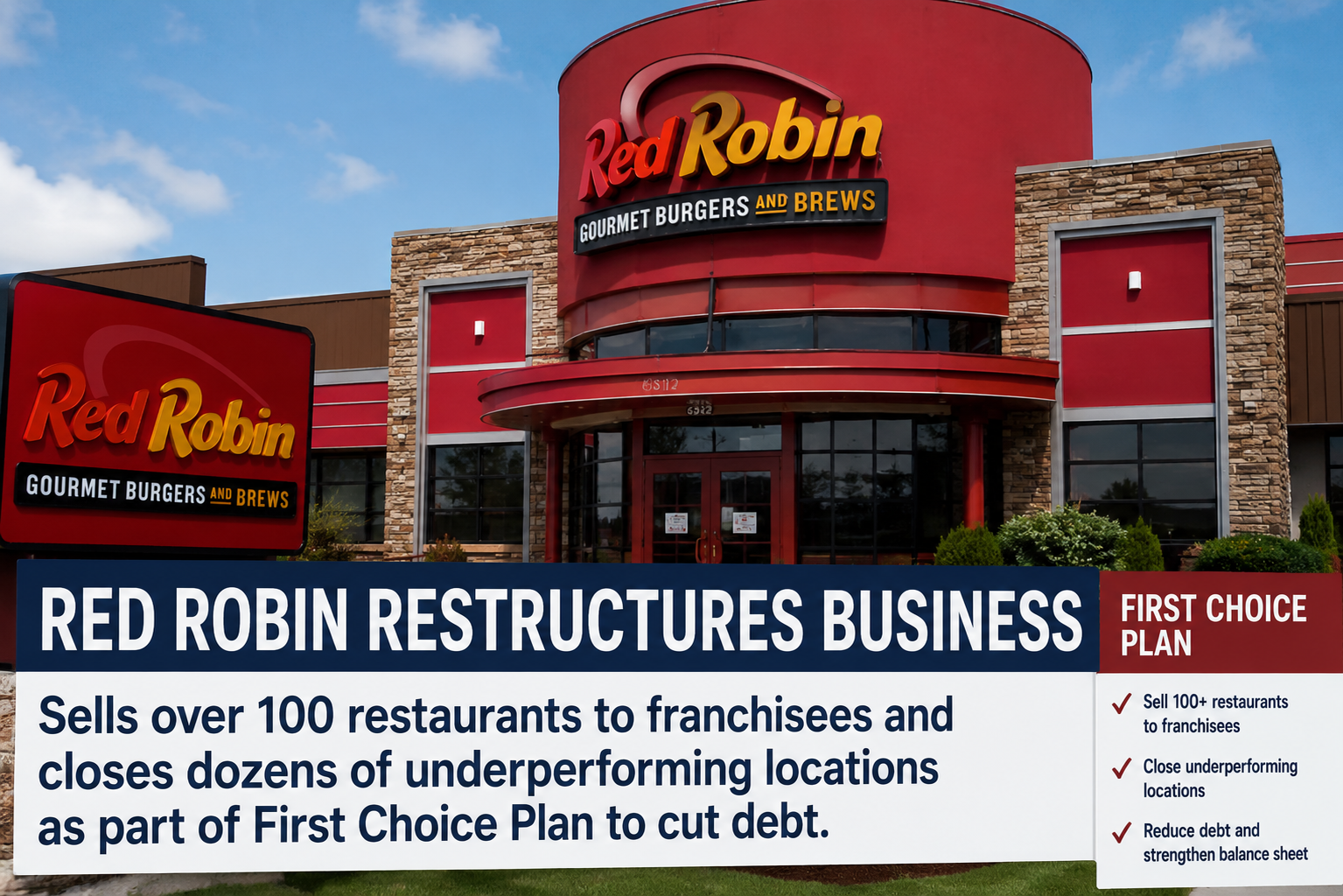
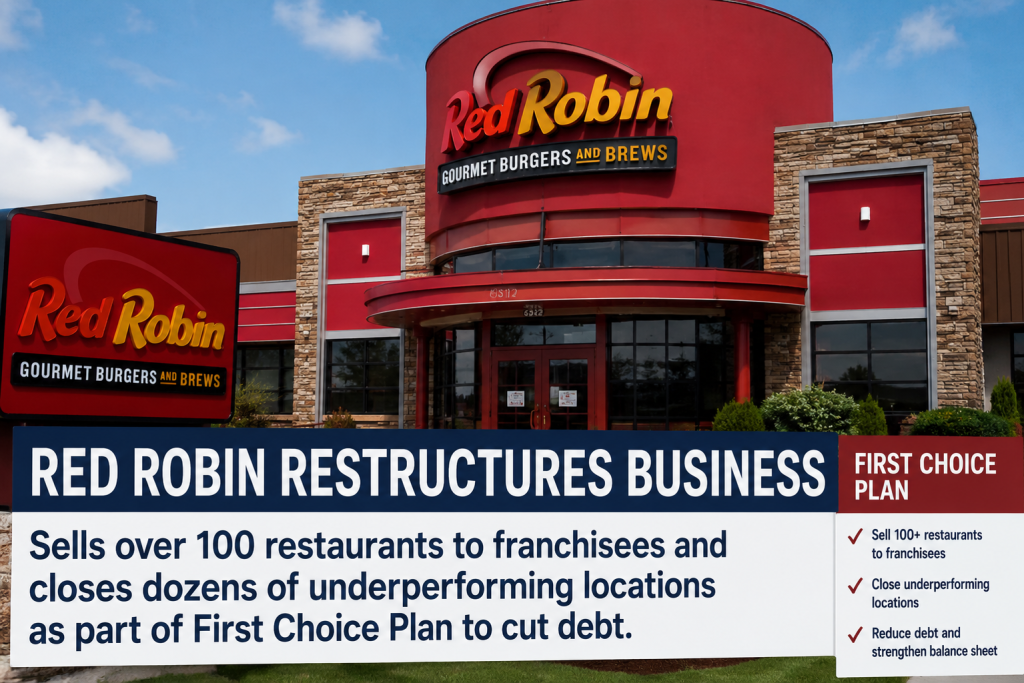
Red Robin is restructuring its business under its First Choice Plan, selling over 100 restaurants to franchisees and closing dozens of underperforming locations to cut debt.

What Is The First Choice Plan
Red Robin launched the First Choice Plan in July 2025. The plan has three main goals: selling company-owned restaurants to franchise operators, cutting company expenses, and reducing debt. The plan followed several years of declining customer visits and financial pressure, according to The Street.
Roger Rogoff Trump Administration Dismissal | Seattle US Attorney Fired in Under an Hour
Roger Rogoff was fired by President Trump less than an hour after federal judges swore him in as U.S. Attorney for the Western District…

Why Red Robin Needed To Restructure
By mid-2025, Red Robin was carrying $169.2 million in outstanding debt. As of April 19, 2026, that number had grown to $175.7 million, with about $40.8 million in available liquidity. The company reported a net loss of $2.2 million in the first quarter of 2026, compared to a $1.2 million loss during the same period the year before, according to WhatNow.
Major Refranchising Deals
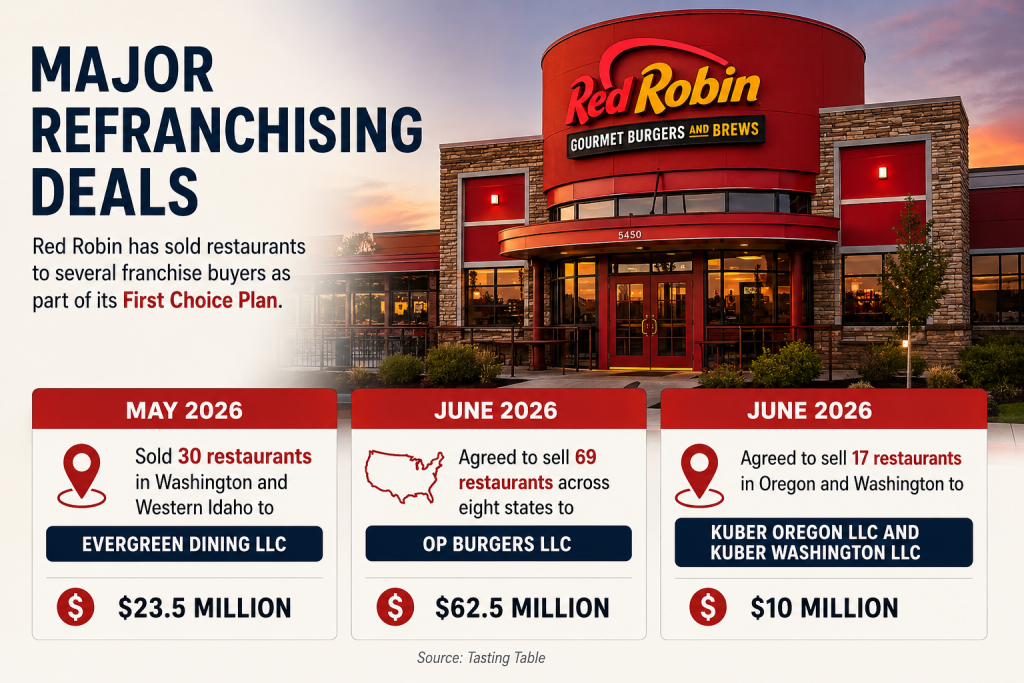
Red Robin has sold restaurants to several franchise buyers as part of this plan. In May 2026, the company sold 30 restaurants in Washington and Western Idaho to Evergreen Dining LLC for $23.5 million. In June 2026, Red Robin agreed to sell 69 restaurants across eight states to Op Burgers LLC for $62.5 million, and another 17 restaurants in Oregon and Washington to Kuber Oregon LLC and Kuber Washington LLC for $10 million, according to Tasting Table.
| Buyer | Locations Sold | States | Deal Value |
|---|---|---|---|
| Evergreen Dining LLC | 30 | Washington, Western Idaho | $23.5 million |
| Op Burgers LLC | 69 | 8 states | $62.5 million |
| Kuber Oregon LLC & Kuber Washington LLC | 17 | Oregon, Washington | $10 million |
How Many Restaurants Are Closing
Red Robin originally identified about 70 underperforming restaurants for possible closure. Strong performance improvements allowed the company to remove 20 of those locations from the closure list. However, the company now expects to close 20 additional restaurants in 2026 as store leases expire, bringing the closure total back up to roughly 70. Red Robin has also said it may close up to 27 more locations over the next several years, according to IBTimes Australia.
Financial Results So Far
In 2025, Red Robin closed 23 locations and repaid $20.3 million in debt. Restaurant-level operating margin improved to 12.7 percent, a gain of 190 basis points from the year before. Earnings before interest, taxes, depreciation, and amortization rose 53 percent to $69.7 million in 2025, according to TheStreet.
What Ownership Will Look Like After The Changes
If all the announced deals are completed, more than 43 percent of Red Robin locations will be franchisee owned. The restaurants involved in these sales will keep operating under the Red Robin name, so customers will not see a change in branding or menu at these locations, according to Tasting Table.
How Red Robin Compares To Other Chains In 2026
Several casual dining chains have faced serious financial trouble in 2026. FAT Brands Inc. filed for Chapter 11 bankruptcy protection on January 26, 2026, and closed 15 Smokey Bones locations while converting 19 more into Twin Peaks restaurants. OTB Hospitality, the company behind On The Border Mexican Grill & Cantina, filed for Chapter 7 liquidation on June 19, 2026, after closing its company-owned locations, according to International Business Times. Red Robin’s approach, selling restaurants to franchise owners rather than shutting them down entirely, has so far avoided the more severe outcomes seen at these other chains.
FAQ: Red Robin Business Restructuring
Q: What is the Red Robin business restructuring plan?
Red Robin’s business restructuring is centered on its “First Choice Plan,” launched in July 2025 with three main goals: refranchising company-owned stores, cutting costs, and paying down debt. The plan followed years of declining foot traffic and financial strain that had pushed the chain’s debt above $169 million by mid-2025.
Q: Why is Red Robin restructuring its business?
Q: How many Red Robin locations are closing?
The number has shifted as the plan has progressed. Red Robin originally flagged around 70 locations for potential closure, then removed 20 of them from that list after seeing operational improvements. However, the company later said it expects roughly 20 additional closures in 2026 as more store leases expire, bringing the total back up to around 70. Beyond that, Red Robin has signaled it may close as many as 27 more locations over the next several years, though no specific list has been released.
Q: Is Red Robin selling restaurants instead of just closing them?
Yes — a major part of the strategy involves refranchising rather than shutting stores outright. Recent deals include the sale of 30 restaurants in Washington and Western Idaho to Evergreen Dining LLC for $23.5 million in May 2026, and two additional agreements in June: 69 restaurants sold to Op Burgers for $62.5 million, and 17 restaurants in Oregon and Washington sold to Kuber Oregon and Kuber Washington for $10 million. In total, these transactions cover 86 restaurants valued at $72.5 million.
Q: Will these restaurants still operate under the Red Robin name?
Q: What happens to the money from these sales?
Q: Is Red Robin’s restructuring working?
Early results appear positive. In 2025, Red Robin closed 23 locations, reduced debt by $20.3 million, and improved restaurant-level operating margin to 12.7% — a 190 basis point improvement year-over-year. Additionally, EBITDA increased 53% to $69.7 million in 2025. Investor sentiment has also improved — the company’s stock rose more than 23% after its mid-June refranchising announcement.
Q: Is Red Robin going bankrupt?
No. Unlike some other casual dining chains that have filed for bankruptcy in 2026, Red Robin’s restructuring is a proactive turnaround strategy rather than a bankruptcy filing. This stands in contrast to companies like FAT Brands, which filed for Chapter 11 in January 2026, and OTB Hospitality, which filed for Chapter 7 liquidation in June 2026.
Q: What will Red Robin look like after the restructuring?
Q: How is Red Robin performing financially right now?
As of its most recent quarter, Red Robin reported a net loss of $2.2 million, compared to $1.2 million in the same period the prior year, with $175.7 million in outstanding borrowings and about $40.8 million in liquidity as of April 19, 2026. Despite the loss, the company maintained its full-year guidance, projecting comparable restaurant revenue growth of 0.5% to 1.5% and adjusted EBITDA between $70 million and $73 million.